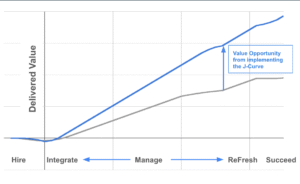
They are consuming resources, not producing them. This is the dip at the start of the ‘J’.
In the old world, we tolerated a long, shallow dip because we assumed we had ten years to recoup the investment. We allowed a slow “ramp-up.” Today, if an employee stays for only 24 to 36 months, a slow ramp-up is fatal. By the time they are fully productive, they are already looking at the door.
The CEO’s imperative is to steepen the slope of that J-Curve. We must shorten the time to value (TTV) and push the peak of contribution higher and faster.
But here is where most leaders fail. They attempt to steepen the curve by demanding “more”, more hours, more emails, more speed. They confuse intensity with impact .
Intellect vs. Energy: The Art of the Good Challenge
There is a profound misunderstanding in management that employees leave because they are “working too hard.”
In my experience, top talent rarely leaves because they are exhausted by the challenge; they leave because they are exhausted by expending their energy on triviality. They leave because their energy is drained by bureaucracy, micromanagement, and friction, while their intellect atrophies.
People enjoy being challenged. There is a visceral satisfaction in solving a wicked problem, in stretching one’s capabilities, and in achieving flow . This is the “Right Way” to accelerate ELTV.
● Bad Acceleration (Energy-based): “I need this report by 8:00 AM tomorrow.” This taxes time and health. It leads to burnout and resentment.
● Good Acceleration (Intellect-based): “Here is a complex market barrier we haven’t cracked. I’m giving you the autonomy to solve it. What do you need from me?” This taxes creativity and skill. It leads to engagement and growth.
When you challenge an employee’s intellect, you unleash potential immediately . You turn the passive “onboarding” phase into active “contribution.” You tell them, “We hired you for your brain. Use it now.”
The Technology Trap: The CEO’s Distraction
We are currently awash in Human Capital Management (HCM) technology. AI-driven engagement platforms, sentiment analysis bots, and automated learning pathways promise to manage the workforce for us.
For many CEOs, this technology has become a dangerous sedative. It is tempting to look at a dashboard of “Employee Sentiment Scores” and believe you are leading. You are not. You are merely observing.
Technology often reduces administrative friction, but it cannot replicate the friction of growth . AI can schedule a meeting, but it cannot look a high-potential leader in the eye and ask, “Is this the best work you are capable of?”
In fact, the ubiquity of technology makes direct, courageous human leadership more essential, not less. As AI commoditises execution, the human ability to mentor, to remove blockers, and to inspire intellectual bravery becomes the sole differentiator. Do not let your tech stack become a wall between you and your people. Use tech to clear the administrative debris so you can spend your time doing the one thing an algorithm cannot: empowering potential.
Unleashing Potential at Every Stage: The Succession Engine
If we accept that tenure is shrinking, then we must also accept that relying on “irreplaceable” talent is a strategic failure.
For the unprepared organisation, the departure of a high performer is a derailment, a full-scale departure from the highway that halts momentum and destroys value. For the leader focused on ELTV, however, a departure is merely a bump in the road. It is a gear shift, not a breakdown.
This resilience is not achieved by panic-hiring when a resignation letter lands. It is the natural byproduct of applying the J-Curve philosophy across your entire hierarchy.
When you are obsessively focused on unleashing potential, you are constantly assessing not just current performance, but future readiness. You are monitoring the J-Curve of the Director, as well as the J-Curve of the Manager reporting to them.
The Overlapping Curves Strategy. True bench strength is created when these curves overlap strategically. As a high performer reaches the peak of their curve, where their mastery is high but their learning rate (and engagement) may be plateauing, their successor should be accelerating up the steep part of their own curve, hungry for new challenges. Note: for the incumbent, you should still assess where there is greater potential for value creation and advancement.
In this model, succession planning is not a secret document hidden in HR’s drawer; it is a transparent, living, dynamic process.
● Radical Readiness Assessment: We must stop guessing when people are ready to step up. By constantly challenging your emerging talent’s intellect, you stress-test their capabilities in real time. You know exactly who can take the wheel because they have already been driving portions of the route.
● The “Gap” is the Growth: When a senior leader leaves, do not view the void they leave as a risk; view it as the necessary space for the next layer of talent to steepen their J-Curve. If you have built true bench strength, the “vacancy” is actually an injection of energy for the successor.
By synchronising these curves, you ensure that the exit of one individual triggers the elevation of another. The organisation does not slow down; it simply reloads. This is how you turn high turnover from a liability into a mechanism for constant organisational renewal.
The Leadership Imperative
The uncomfortable truth is that the “Retention at all Costs” model was easy. It required only steady increments of salary and security.
The “J-Curve” model is hard. It requires leaders to be present, to demand intellect yet protect energy, and to constantly facilitate the unleashing of potential from day one to day n .
Your employees will not be with you forever. That is a fact. The question is: Will you spend their time here trying to hold them down, or will you lift them so high that they eventually fly away, leaving a trail of immense value behind them?