
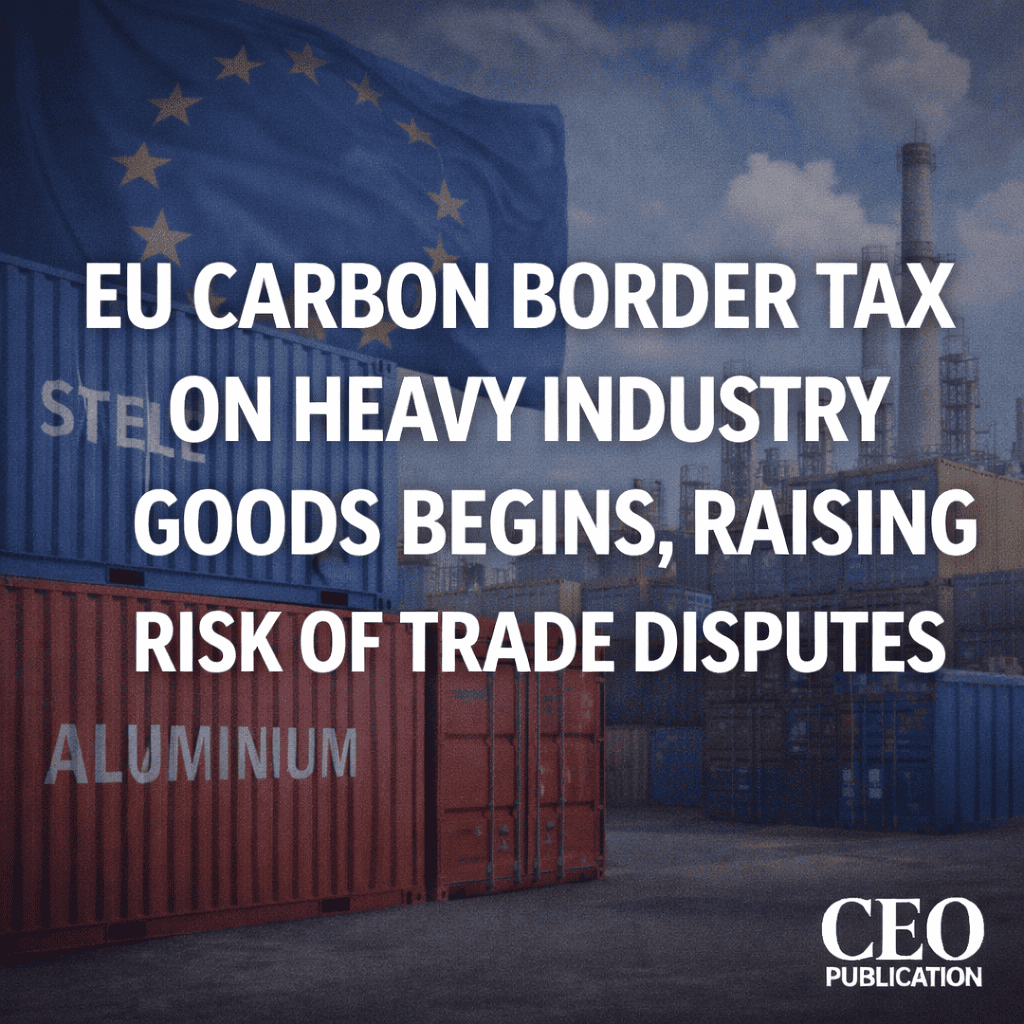
The EU carbon border tax on heavy industry goods has formally taken effect, marking a turning point in how climate policy intersects with international trade. From January 1, importers bringing carbon-intensive products into the European Union must comply with new emissions-reporting rules under the bloc’s Carbon Border Adjustment Mechanism, a system designed to align foreign producers with EU climate costs.
The EU carbon border tax on heavy industry goods covers sectors with high emissions intensity, including steel, cement, aluminium, fertilisers, electricity, and hydrogen. These industries were previously protected within the EU through free emissions allowances, a safeguard that will now be gradually withdrawn. By extending comparable carbon costs to imports, Brussels aims to prevent domestic producers from being undercut by goods manufactured in countries with weaker climate standards.
Under the new framework, importers must declare the embedded carbon emissions in covered goods and, over time, purchase certificates priced in line with the EU carbon market. While the full financial impact will be phased in, the reporting obligation is already mandatory. EU officials argue that the EU carbon border tax on heavy industry goods is essential to stop carbon leakage, where production shifts abroad to avoid environmental costs.
Reaction beyond Europe has been mixed. Several exporting countries warn that the EU carbon border tax on heavy industry goods could operate as a trade barrier, particularly for economies that rely on fossil fuels or lack access to low-carbon technologies. Critics argue that even efficient producers may face penalties simply because their national energy mix differs from Europe’s.
Concerns about retaliation are growing. Some governments are assessing countermeasures, while others are preparing challenges through the World Trade Organization, questioning whether the policy respects global trade rules. The EU maintains that the EU carbon border tax on heavy industry goods is non-discriminatory because it mirrors costs faced by EU companies and applies uniformly to imports and domestic production.
Inside Europe, industry views are divided. Heavy manufacturers generally support the mechanism, seeing it as a way to preserve competitiveness during the green transition. Downstream sectors, however, warn that higher input prices could cascade through construction, infrastructure, and food production, raising costs for consumers and businesses alike.
One overlooked avenue for easing tensions lies in international coordination. Mutual recognition of carbon pricing systems could reduce duplication, while technical assistance for emissions monitoring in developing economies could limit friction without diluting the EU carbon border tax on heavy industry goods. (Speculation: transitional arrangements tied to verified decarbonisation plans may be introduced to stabilise trade relationships.)
The rollout of the EU carbon border tax on heavy industry goods signals a broader shift: climate regulation is now shaping trade policy, industrial strategy, and diplomacy simultaneously, positioning the EU at the centre of a global debate on how carbon costs should be shared across borders.