
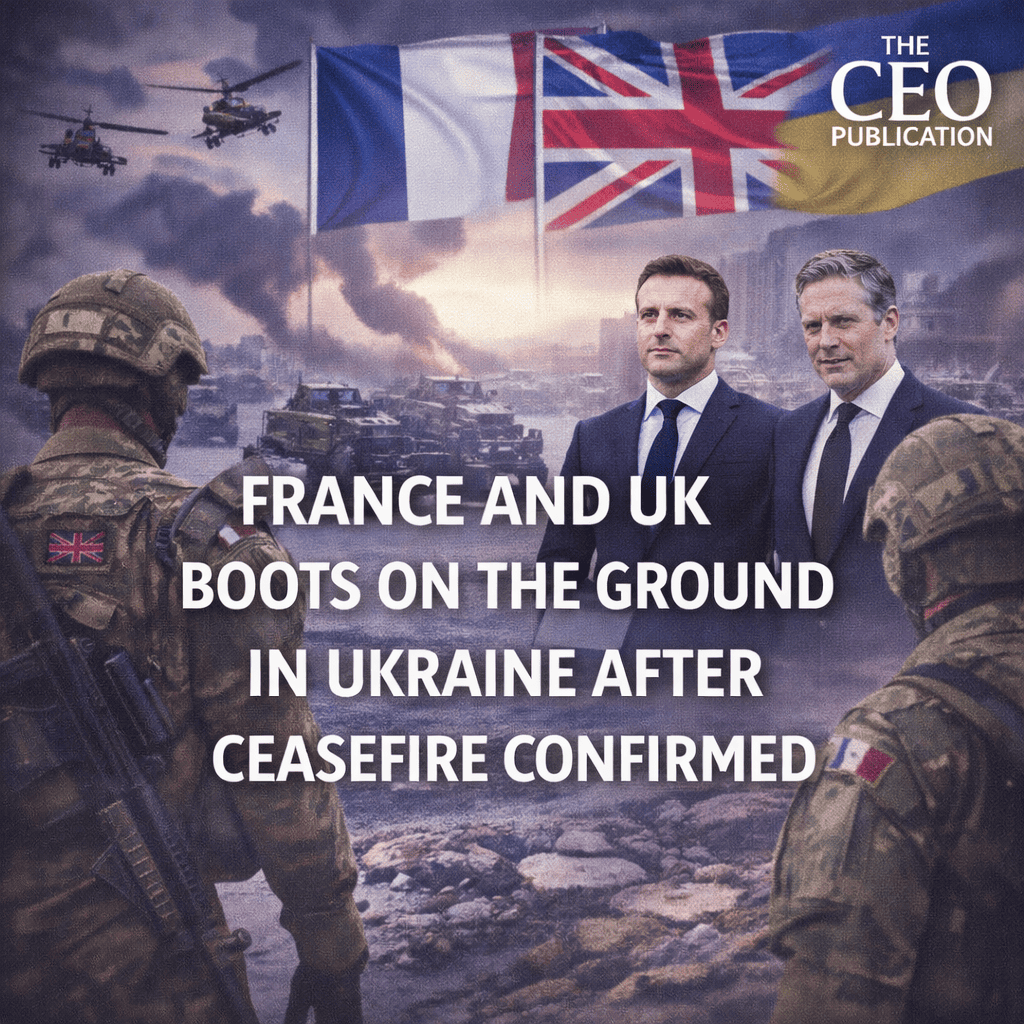
France and UK boots on the ground in Ukraine after the ceasefire have moved from political speculation to confirmed planning, signalling a new phase in Europe’s approach to post-war security. Following high-level talks in Paris among the so-called “Coalition of the Willing,” London and Paris have agreed that their forces would deploy inside Ukraine once a ceasefire is formally in place.
The commitment is framed as a stabilisation and deterrence mission rather than frontline combat. French and British officials emphasise that any deployment would occur only after active hostilities stop, to prevent renewed aggression and reinforce Ukraine’s ability to defend itself. In this context, France and the UK boots on the ground in Ukraine after the ceasefire represent a guarantee mechanism rather than an escalation.
The emerging blueprint focuses on structure over symbolism. European planners are discussing the creation of military coordination hubs across Ukraine, supported by logistics sites, training facilities, and secure storage for equipment. These hubs would help rebuild Ukrainian forces and ensure a rapid response capability in the event of ceasefire violations. The intention is to make renewed conflict costly and visible from the outset.
Political constraints remain central. In the UK, Prime Minister Keir Starmer has confirmed that any deployment of British troops would require parliamentary approval, underscoring domestic oversight and limits on executive authority. France has indicated openness to a sizeable contribution, but troop numbers, basing arrangements, and command structures remain under negotiation. Even so, France and the UK boots on the ground in Ukraine after the ceasefire now sit within a formal diplomatic framework rather than abstract discussion.
The role of allies outside Europe is deliberately ambiguous. While US participation has been described as “proposed” rather than guaranteed, European leaders see American political backing as essential for credibility. The initiative reflects Europe’s growing willingness to shoulder direct responsibility for continental security, even as it seeks to keep Washington closely aligned.
Strategically, the plan aims to address a core weakness of previous ceasefires: enforcement. European officials fear that, without a visible international presence, a pause in fighting could pave the way for rearmament. By committing to France and the UK’s boots on the ground in Ukraine after the ceasefire, Paris and London intend to create a deterrent that raises the threshold for renewed military action.
Several elements could strengthen the mission’s effectiveness. Clear rules of engagement and geographic limits would reduce miscalculation. A transparent ceasefire monitoring system combining satellite data, drones, and on-the-ground reporting could provide shared situational awareness. Long-term funding and rotation plans would ensure the deployment remains sustainable rather than symbolic. (Speculation: a permanent EU-led security mission could eventually replace ad-hoc arrangements.)
Ultimately, France and the UK’s boots on the ground in Ukraine after the ceasefire reflect a shift in Europe’s strategic mindset. Rather than relying solely on promises and sanctions, European powers are preparing to anchor peace with physical presence, accepting the political and military risks that come with that choice.