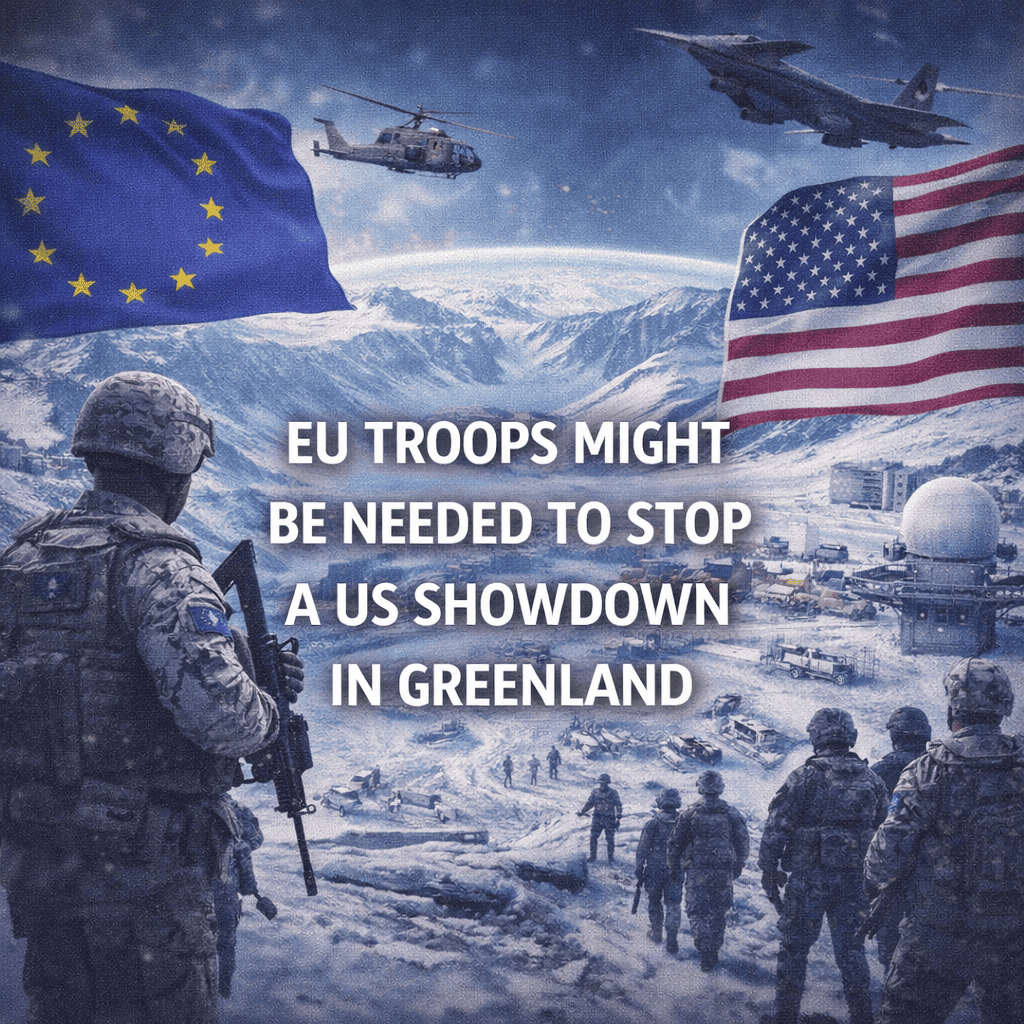
EU troops might be needed to stop a US showdown in Greenland—a phrase that until recently sounded implausible now sits at the centre of Europe’s Arctic debate. European lawmakers argue that if pressure on Greenland intensifies, the EU must be ready to move beyond statements and prepare a stabilising presence to prevent coercion inside the Western alliance.
The warning comes as renewed US rhetoric revives questions about control over Greenland, a self-governing territory within the Kingdom of Denmark. European leaders insist the island’s future belongs to its people and cannot be negotiated by external powers. Yet many in Brussels fear that declarations alone may not deter a unilateral move if strategic or economic interests escalate.
Supporters of a preventive posture argue that EU troops might be needed to prevent a US showdown in Greenland, not as a hostile act but as a de-escalation tool. The logic mirrors peacekeeping doctrine: a visible, neutral presence can slow momentum, reduce miscalculation, and create space for diplomacy. In this framing, deployment is not about confrontation but about anchoring sovereignty while talks proceed.
The strategic context is shifting fast. Arctic routes are becoming commercially viable. Surveillance corridors across the High North now matter for missile defence and early warning. Greenland also holds deposits of critical minerals needed for batteries and advanced manufacturing. These forces compress timelines and heighten the risk that security arguments slide into leverage over territory.
Europe points out that Washington already has extensive military access. The United States operates from Pituffik Space Base under long-standing defence agreements with Denmark, giving it early-warning and space-tracking capabilities across the Arctic. For European officials, this undercuts claims that control over Greenland is required for US security.
That is why many capitals prefer a NATO-first solution. A standing Arctic mission focused on surveillance, maritime presence, and rapid reinforcement would address security gaps without touching sovereignty. Within that framework, EU troops might be needed to stop a US showdown in Greenland only as a last-resort backstop—activated if alliance mechanisms fail to contain escalation.
Several practical steps could reduce the chance of reaching that point:
- Expand NATO’s Arctic footprint with joint air and maritime patrols agreed by Denmark and Greenland.
- Lock any facility upgrades into consent-based frameworks overseen by parliaments in Copenhagen and Nuuk.
- Build EU–Greenland partnerships on infrastructure and minerals under Greenlandic control, reducing the appeal of external pressure. (Speculation, flagged.)
The core risk is an alliance fracture. A standoff within the Western bloc would give external rivals leverage and weaken Europe’s broader security posture. Preparing for a preventive role does not mean seeking confrontation. It signals that EU troops might be needed to stop a US showdown in Greenland because sovereignty in Europe cannot hinge on power alone.
In the Arctic, speed is becoming a strategy. Europe’s task is to ensure that momentum is channelled through law, consent, and collective security—before rhetoric hardens into a crisis.