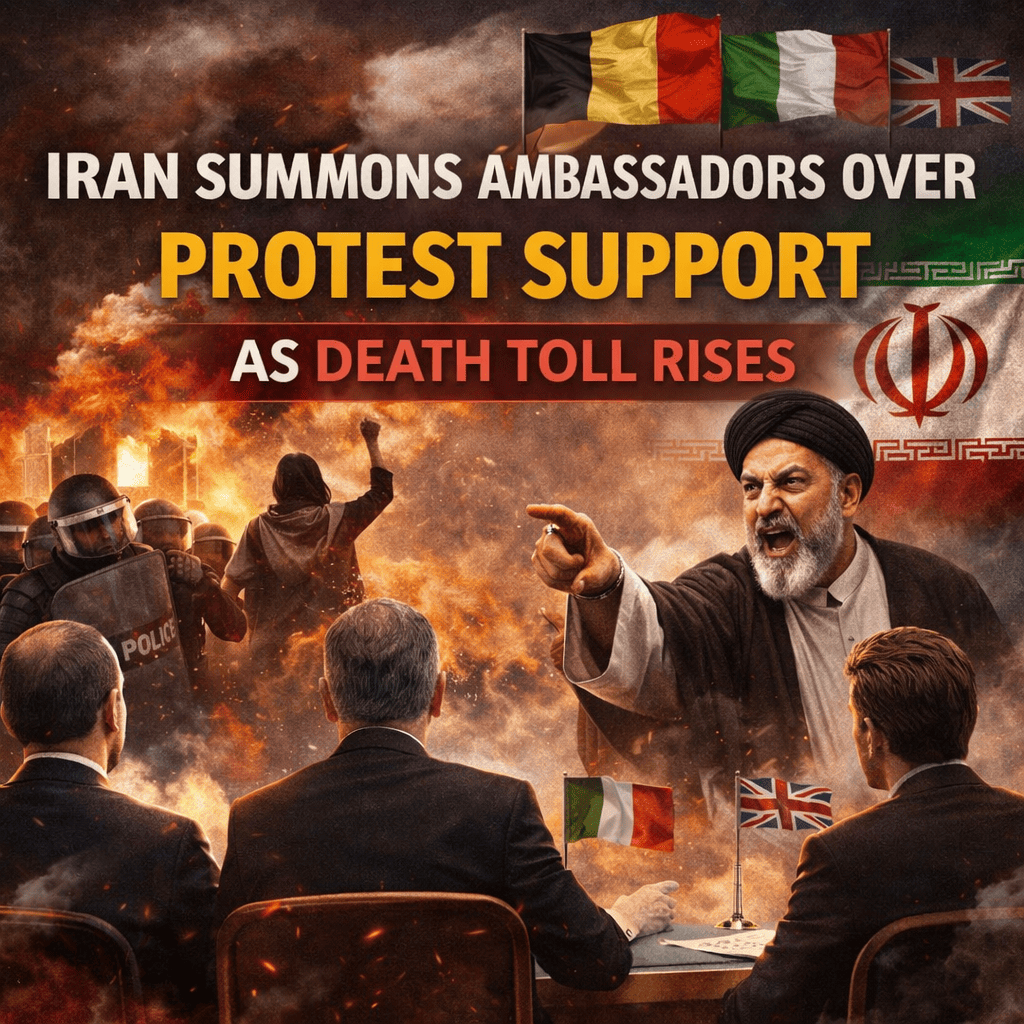
Iran summons ambassadors over protest support as the government broadens its response beyond the streets and into diplomacy, calling in envoys from central European states to demand an end to public backing for demonstrators. Tehran summoned the ambassadors of France, Germany, Italy, and the United Kingdom, accusing their governments of interfering in Iran’s internal affairs by condemning the crackdown and expressing solidarity with protesters.
According to Iranian officials, the envoys were shown footage of damaged public property and were told that Western statements had “encouraged disorder.” State media framed the unrest as coordinated sabotage rather than civil protest, insisting that foreign powers were exploiting economic hardship to destabilize the country. The diplomatic rebuke marks a shift from crowd control to narrative control, aiming to contain not only unrest but also its global framing.
The summons comes as casualty figures continue to climb. Rights groups monitoring events say hundreds of people have been killed and more than 10,000 detained since protests began in late December. What started as demonstrations over inflation and living costs has evolved into broader opposition to Iran’s leadership. Authorities have not released a comprehensive national toll, and the government disputes activist counts.
Inside Iran, officials have paired enforcement with mobilisation. Leaders have urged citizens to attend pro-government rallies, presenting turnout as proof of national unity and a warning to foreign powers. Supreme Leader Ayatollah Ali Khamenei has linked the protests directly to external pressure, arguing that the unrest forms part of a broader campaign against the Islamic Republic.
Communication restrictions remain central to the strategy. Internet access has been throttled across large parts of the country, limiting the spread of videos, slowing coordination among demonstrators, and reducing the flow of independent reporting. The blackout also complicates verification, giving the state greater control over what reaches audiences at home and abroad.
The diplomatic dimension is unfolding alongside sharper rhetoric from Washington. U.S. President Donald Trump has said Tehran has sent mixed signals—hinting at talks while the crackdown continues—and warned that “strong options” remain under consideration. Iran’s decision to summon ambassadors appears designed to raise the political cost for European governments of continued public alignment with protesters, especially as Brussels weighs further measures.
Iran summons ambassadors over protest support, not simply as a protest, but as leverage. By formalising objections, Tehran places European capitals in a bind: soften their tone or accept a deterioration in bilateral ties. The move also tests whether Europe will maintain a unified stance or drift toward quieter diplomacy.
What follows will shape the next phase of the crisis. More summons are likely if statements continue. Coordinated European measures could follow if casualty reports continue to rise. The information battle will intensify, with Tehran amplifying “foreign plot” narratives while activists develop new ways to document events under blackout conditions.
Speculation (flagged): If demonstrations persist at scale, Iran may attempt to split Europe from the United States by offering selective diplomatic channels to some capitals while sustaining public pressure through repeated summons and media campaigns. The goal would be to narrow the coalition speaking on behalf of the streets—without conceding control at home.