
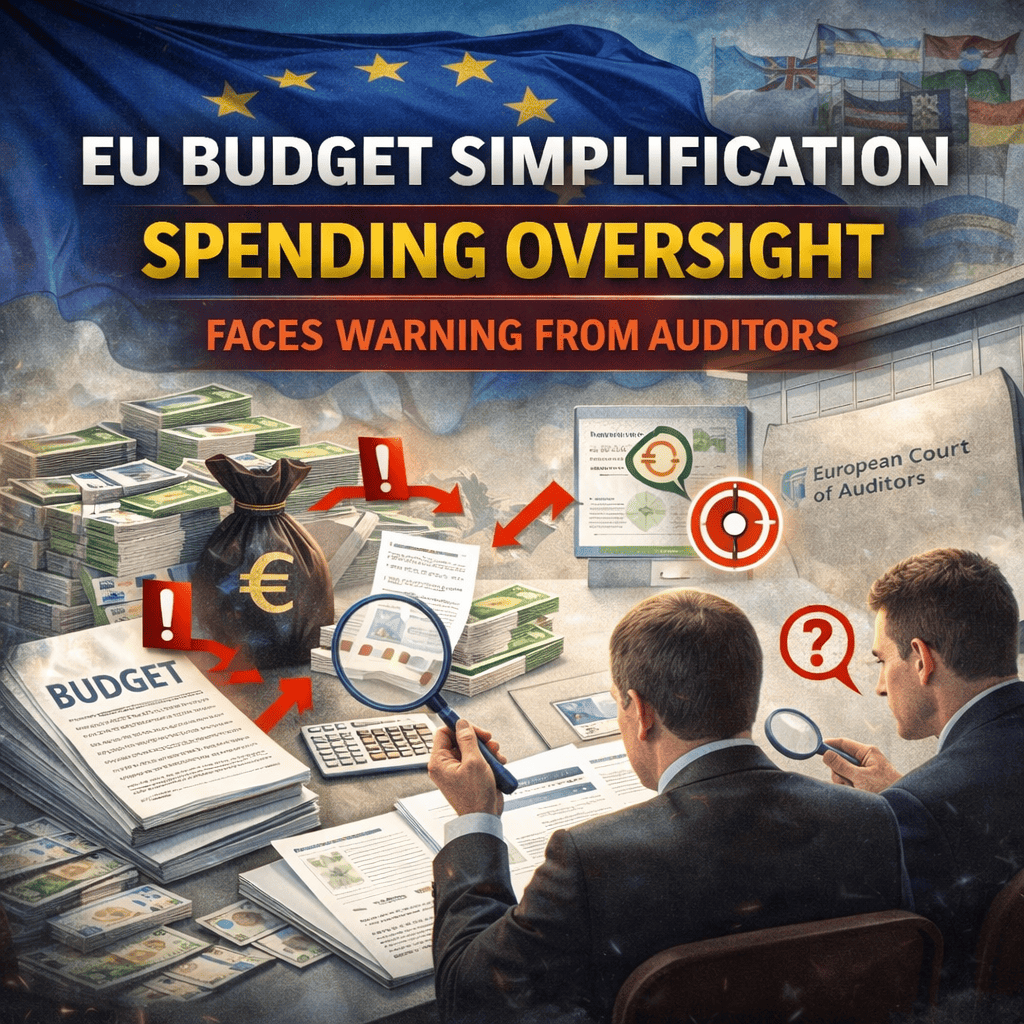
EU budget simplification spending oversight is emerging as a central fault line in Brussels as the European Court of Auditors warns that plans to simplify the next long-term EU budget could erode control over how public money is spent. The concerns focus on the Commission’s proposals for the 2028–2034 financial framework, especially the competitiveness and research pillars, which together could account for roughly one-fifth of a projected €2 trillion budget.
Auditors argue that the push for more straightforward rules risks sacrificing clarity for convenience. In areas such as research and innovation, error rates are already high, and the move toward broader use of lump-sum funding may worsen the problem. Under this model, projects receive fixed amounts based on expected outputs rather than reimbursed costs. While the system reduces paperwork, it also weakens the ability to verify whether EU funds truly deliver value.
The Court’s core message is blunt: simplification should not come at the cost of accountability. Without clear traceability, auditors say, it becomes harder to confirm that money was spent for its intended purpose and easier for beneficiaries to receive more than they are entitled to. Overcompensation—already documented in some programmes—could become structural rather than incidental.
This warning comes amid a broader political drive led by Commission President Ursula von der Leyen to cut red tape and accelerate Europe’s competitiveness agenda. “Simplification” has become a strategic mantra, with omnibus proposals aimed at streamlining funding rules and regulatory frameworks across sectors. Supporters argue that Europe’s innovation system is too slow and fragmented to compete with the United States and China.
Critics inside EU institutions counter that simplification is drifting toward deregulation. Commission vice-president Teresa Ribera has cautioned that removing layers of control can shift risks onto citizens and taxpayers. Members of the European Parliament have also warned that vague funding criteria and flexible reporting standards could weaken democratic scrutiny.
The debate is not about whether rules should be more straightforward—it is about how to design EU budget simplification spending oversight that remains robust under lighter procedures.
Practical solutions exist:
- Every lump-sum payment could be tied to machine-readable proof of delivery—datasets, prototypes, published results—creating an automatic audit trail.
- Benchmark pricing for everyday research activities would limit overcompensation and standardise expectations across member states.
- Continuous digital monitoring could flag anomalies such as repeated beneficiaries, clustered contracts, or inflated output claims before funds are fully disbursed.
- Competitiveness funding could be anchored to precise definitions of “EU added value,” making political objectives auditable rather than rhetorical.
These mechanisms would preserve speed while strengthening control. They would turn EU budget simplification spending oversight into a more intelligent system rather than a thinner one.
The stakes are structural. Once the architecture of the next budget is locked in, reversing weak controls will be politically and technically challenging. The choice facing lawmakers is whether simplification becomes a tool for better governance—or a shortcut that leaves Europe with fewer answers about where its money went and what it achieved.