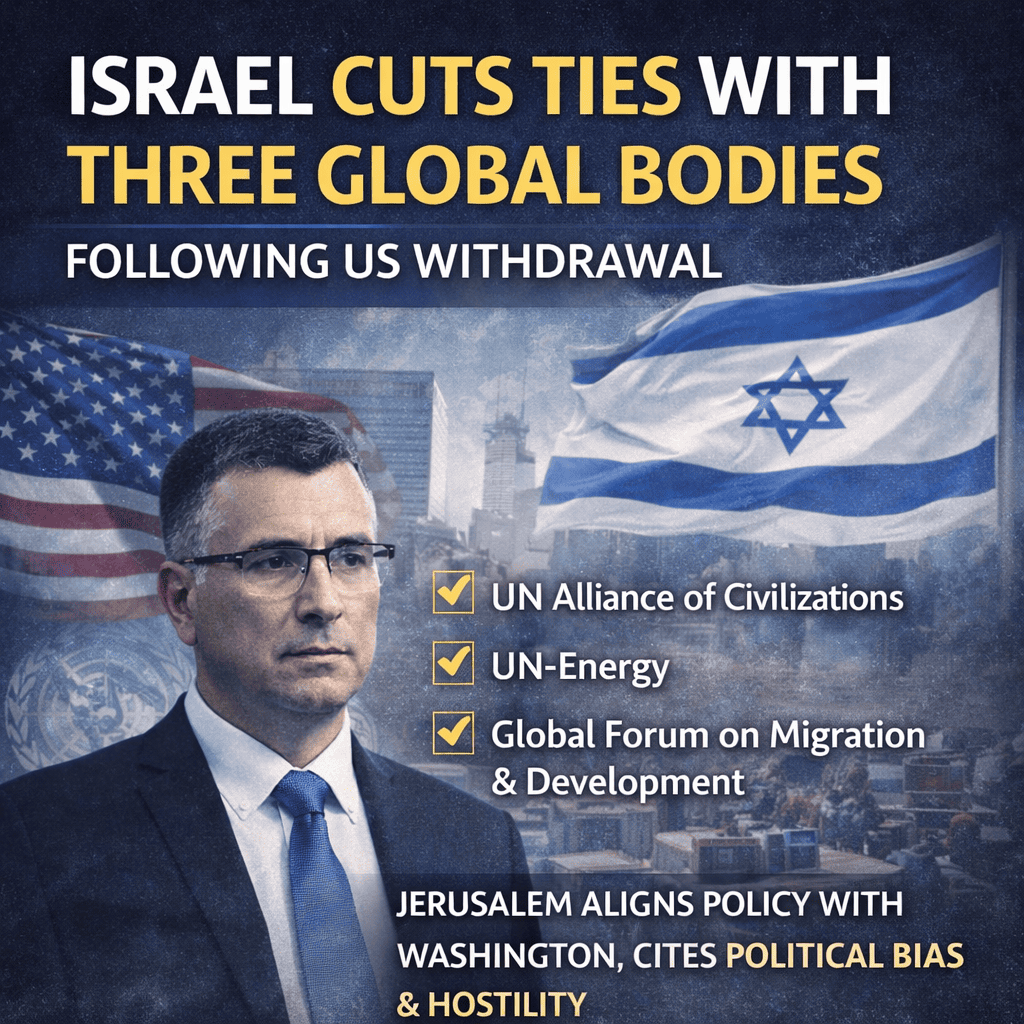
Israel cuts ties with three global bodies after its foreign ministry ordered an immediate halt to engagement with several international organisations that were included in a sweeping U.S. withdrawal from multilateral forums. The decision, announced in Jerusalem, aligns Israel’s posture with Washington’s and reflects a broader reassessment of how the country participates in global institutions.
Foreign Minister Gideon Sa’ar instructed officials to sever all contact with the UN Alliance of Civilizations, UN-Energy, and the Global Forum on Migration and Development. The move follows President Donald Trump’s directive for the United States to exit 66 international organisations, a list that includes UN-linked bodies and independent global platforms.
Israel’s foreign ministry framed the decision as a response to what it described as persistent bias and politicisation inside parts of the multilateral system. Officials argued that some forums have evolved from technical cooperation platforms into arenas for one-sided political pressure, particularly on issues related to Gaza and Israel’s security policy.
The ministry said Sa’ar has also ordered a broader review of Israel’s participation across international organisations. That signals the three cutoffs may represent the first phase of a broader realignment rather than a closed list.
Israel cuts ties with three global bodies at a time when relations with UN-affiliated institutions are already strained. Disputes over humanitarian access, investigative mandates, and public statements by international officials have deepened mistrust between Jerusalem and multilateral bodies. The new policy formalises that tension into a structural shift.
In practical terms, the step affects official coordination, attendance at meetings, data-sharing, and programmatic cooperation with the named bodies. It does not terminate Israel’s relationship with the United Nations as a whole, but it narrows the channels through which Israeli diplomats engage on migration, energy coordination, and intercultural dialogue.
The foreign ministry emphasised that the review is ongoing. Sa’ar instructed officials to assess whether other organisations provide sufficient operational value to justify continued participation. That assessment will likely weigh technical benefit against reputational and political cost.
For Israel, the calculation is increasingly transactional: engage where outcomes are concrete and impartial, withdraw where platforms are perceived as hostile or symbolic. The U.S. exit provides both political cover and strategic alignment for that approach.
What comes next will shape how far the policy extends:
- Whether additional organisations are added following the review
- Whether allies mirror the move or preserve cooperation in technical domains
- How international coordination shifts into alternative formats—regional groups, ad-hoc coalitions, or bilateral frameworks
Speculation (flagged): If more states adopt selective participation, multilateral work may fragment into smaller, interest-based coalitions. Universal forums could lose influence, while operational cooperation migrates to narrower alliances built around trust and measurable outcomes.
Israel cuts ties with three global bodies not as an isolated gesture, but as part of a broader rethink of how power, legitimacy, and effectiveness are distributed in the international system. The decision underscores a growing view among some governments that multilateralism must prove its utility—or risk being bypassed.