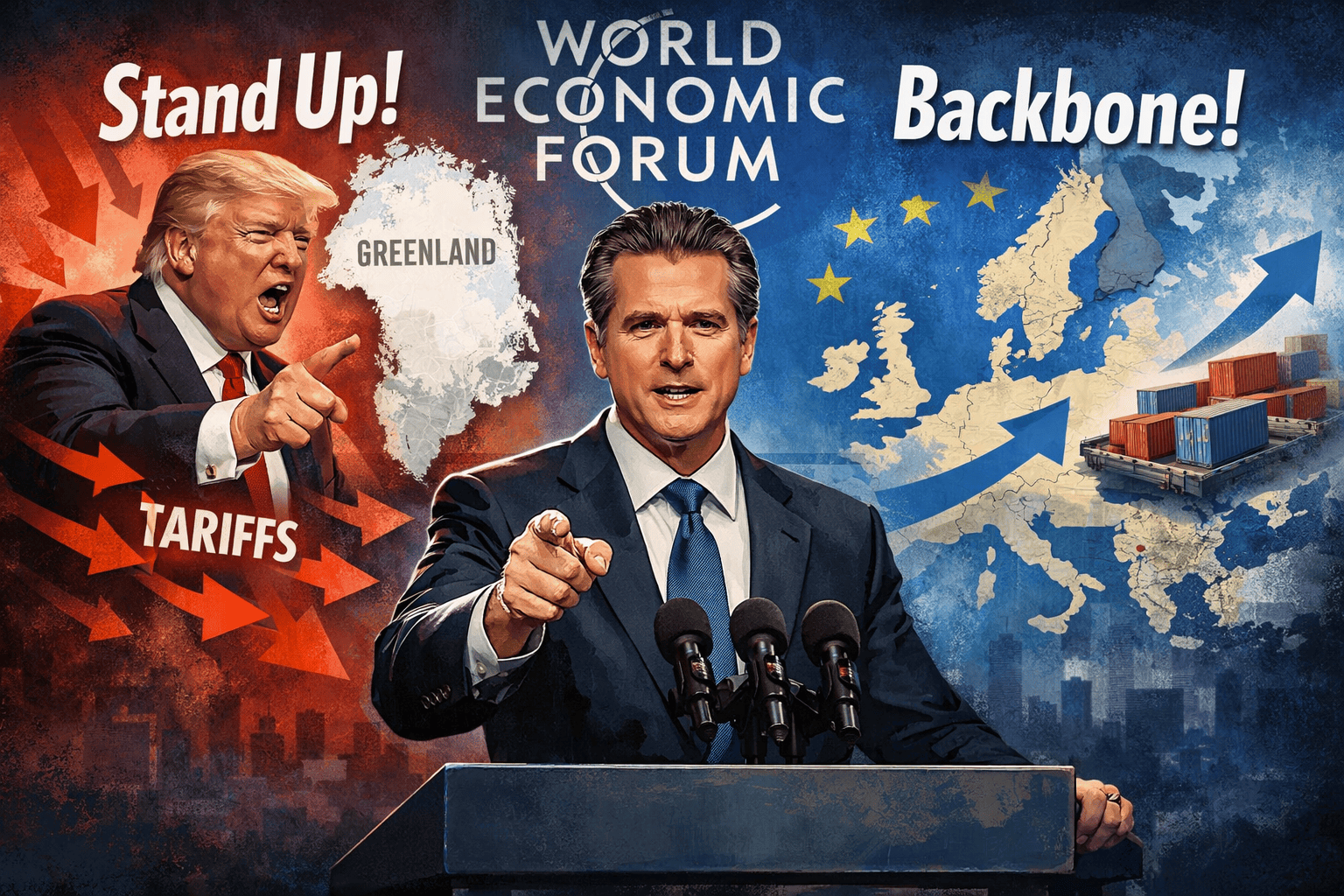
Newsom urges Europe to punch back at Trump—a blunt call delivered by California Governor Gavin Newsom at the World Economic Forum in Davos as transatlantic tensions rise over Washington’s tariff threats linked to Greenland. Newsom argued that European leaders have spent too long trying to placate Donald Trump and should replace caution with collective resolve. In his view, accommodation has only emboldened pressure tactics that blur the line between trade and power.
Speaking on the sidelines of Davos, Newsom accused European capitals of “playing nice” amid coercion. He said the moment calls for backbone, not appeasement, and urged Europe to respond in kind when tariffs are used to force political outcomes. The language was straightforward for a senior US Democrat on European soil—and it landed as Trump prepared to address global business and political elites.
The dispute centers on Trump’s willingness to tie trade penalties to strategic demands, with Greenland becoming the flashpoint. For many in Brussels, the episode is no longer a one-off. It signals a pattern in which tariffs become leverage in geopolitical bargaining. Newsom’s intervention reframed the issue: this is not merely a trade spat, but a test of whether Europe is prepared to defend its decision-making autonomy.
Newsom urges Europe to punch back at Trump for two reasons. First, he sees a failure to respond decisively as tacit permission. Second, he believes only visible costs change behavior in an environment where unpredictability is a feature, not a bug. His message to European leaders was simple: unity and firmness reduce the frequency of future threats; hesitation multiplies them.
The timing matters. EU officials are already debating whether to place tougher instruments on the table if tariff pressure escalates. The bloc’s anti-coercion framework exists precisely for moments when economic tools are used to compel political change. Yet many capitals still prefer diplomacy first, wary of self-inflicted damage in an already fragile economy.
That caution is understandable—but it carries risks. Mixed signals weaken leverage. Fragmented responses invite further testing. Newsom argues that deterrence in trade politics works the same way it does elsewhere: clarity beats ambiguity.
Practical steps are available without triggering a spiral. Europe can coordinate a single public line within days, not weeks. It can pre-brief industries on potential countermeasures to reduce shock. It can design a graduated response—procurement access first, targeted goods next—so the other side sees a clear path to de-escalation. And it can pair firmness with a standing diplomatic channel that offers an off-ramp without loss of face.
Newsom urges Europe to punch back at Trump, believing that respect follows resistance. Whether European leaders adopt that posture now will shape not only this dispute, but the rules of engagement for the next cycle of tariff-driven power plays.