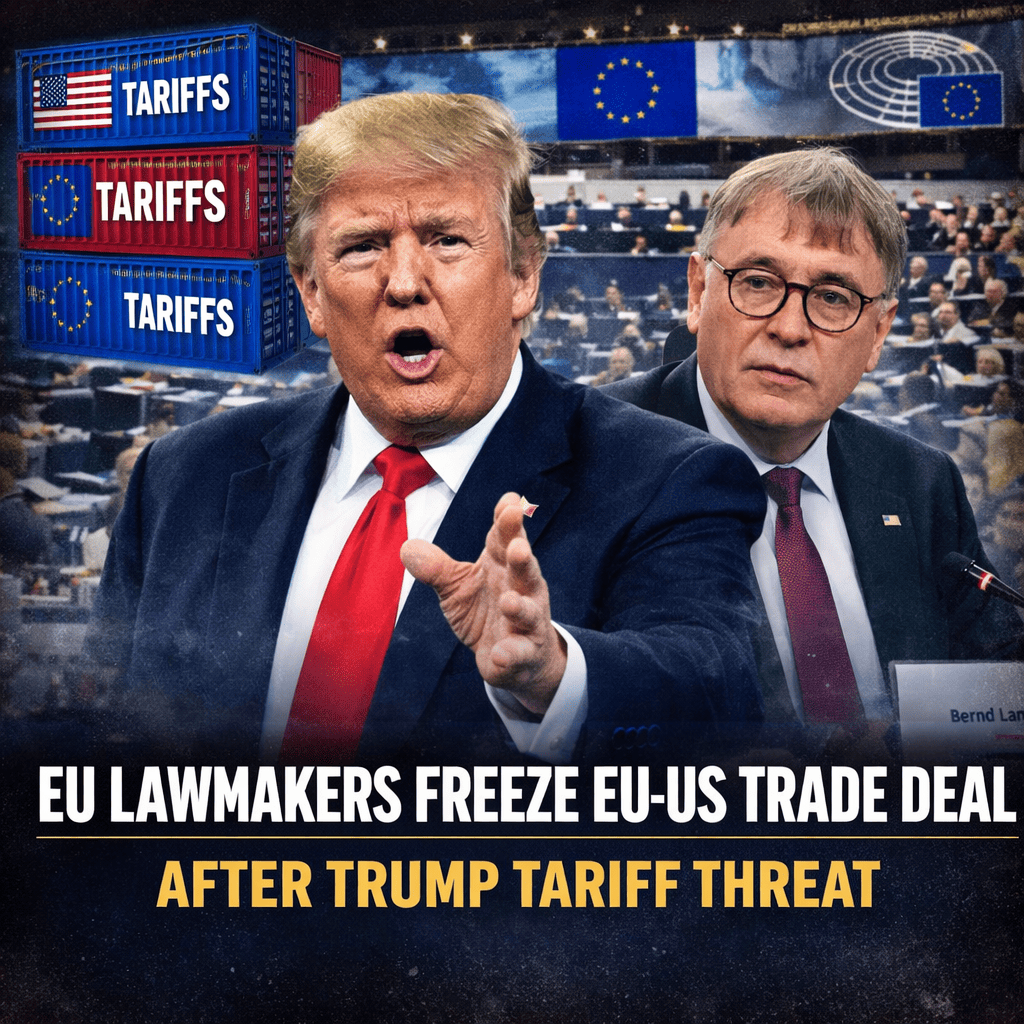
EU lawmakers freeze EU-US trade deal after Donald Trump escalates tariff threats, forcing the European Parliament to halt progress on a transatlantic agreement meant to stabilize commercial ties. The move marks the first concrete institutional response from Brussels to Washington’s use of trade pressure in a geopolitical dispute.
The agreement in question is narrow but symbolically important. It includes EU reductions on selected US imports and an extension of zero-tariff access for American lobsters—an expansion of a deal first struck to calm earlier trade tensions. Parliamentary committees were preparing the final steps required for implementation. Instead, lawmakers voted to put everything on hold.
The reasoning is straightforward: trade negotiations depend on reciprocity and predictability. Tariffs used as leverage against allies break that logic. In committee discussions, lawmakers argued that no concessions can move forward while the United States signals it may punish Europe economically for political positions, including those linked to Greenland.
This is not a procedural delay. It is a message. When EU lawmakers freeze the EU-US trade deal, they are asserting that Europe will not normalize coercion. The pause raises the cost of escalation in Washington without triggering an immediate trade war. Parliament has limited executive power, but it controls ratification. That makes it an ideal brake—high visibility, low collateral damage.
The decision also reflects unease inside the EU about the original agreement. Some lawmakers had already criticized it as lopsided. It survived because it kept disputes contained and markets calm. Tariff threats changed that calculus. What was tolerable as pragmatic diplomacy becomes indefensible when framed as capitulation.
Brussels now faces a design challenge: how to maintain leverage without closing doors.
Three options can turn this freeze into a strategy rather than a stalemate.
First, build a conditional off-ramp. Announce that the trade committee will reconvene the moment tariff threats are withdrawn. Tie every future step to explicit triggers. That turns EU lawmakers’ freeze on the EU-US trade deal into a reversible valve rather than a dead end.
Second, pre-authorize proportional countermeasures. Instead of one dramatic retaliation, prepare a ladder—targeted duties that scale in phases. Predictability deters more effectively than spectacle and reduces the risk of miscalculation.
Third, separate sovereignty from commerce in public messaging. Make it explicit that territorial or security disputes must be handled diplomatically, not through customs codes. If Europe allows that precedent, every future geopolitical disagreement becomes a trade weapon.
Prediction (flagged): if tariff pressure continues, the EU-US trade deal will become Parliament’s template for other files—data governance, tech standards, procurement access. It is an institutional choke point that can be activated quickly and deactivated cleanly.
The pause is not anti-American. It is pro-rules. Europe is signaling that partnership requires boundaries—and that trade cannot become the currency of political compulsion.