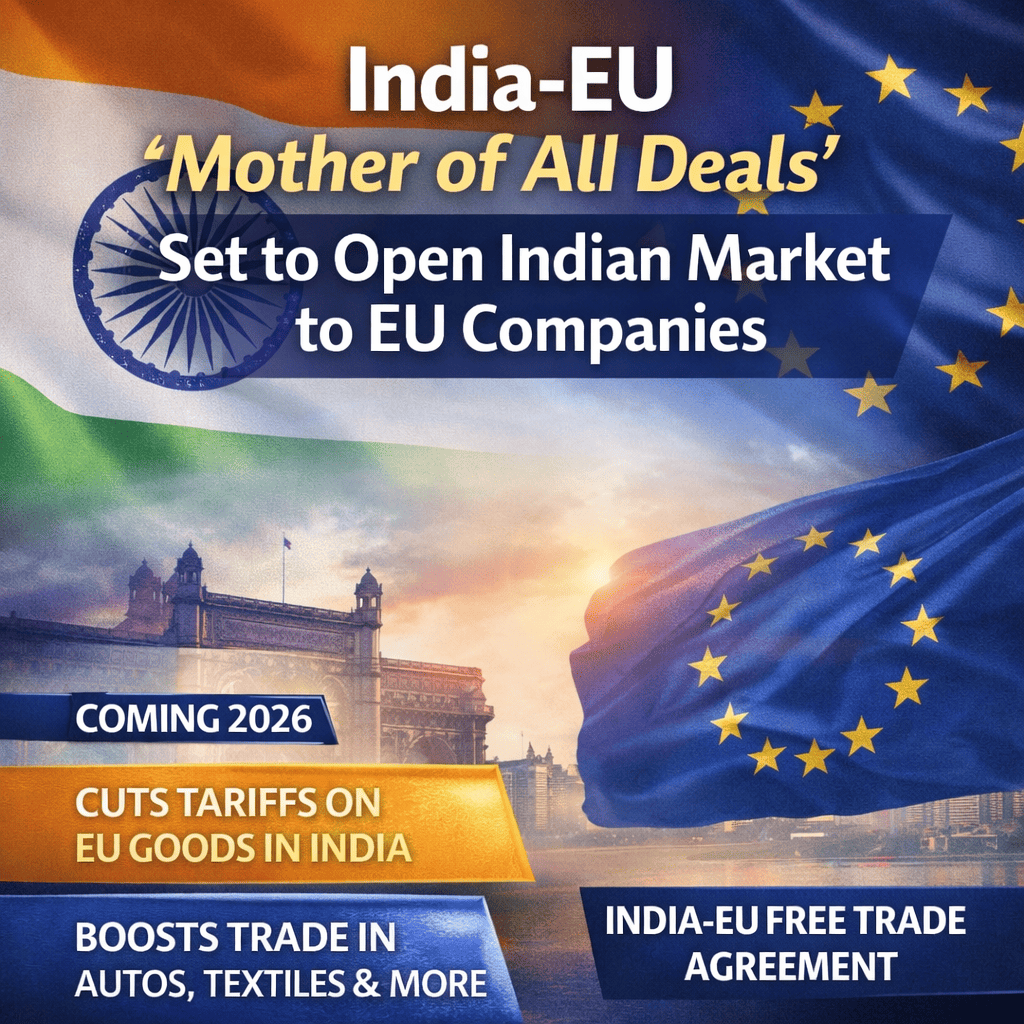
The long-awaited India‑EU ‘Mother of All Deals’ is approaching finalization, with top officials confirming that the agreement will drastically improve market access for European Union companies operating in India. Trade Commissioner Maroš Šefčovič has stated that this deal represents the most comprehensive economic engagement ever agreed upon between the two regions.
Negotiations between India and the European Union have spanned nearly two decades. Now, officials on both sides say the terms are nearly settled. The deal, formally called the India-EU Free Trade Agreement, is expected to reduce or eliminate tariffs on a wide range of goods and services — addressing longstanding complaints from European industries about high Indian import duties.
The India‑EU ‘Mother of All Deals’ specifically targets sectors where European firms have been disadvantaged by India’s steep tariffs, particularly in the automotive and industrial goods markets. Passenger cars from Europe, which currently face import duties as high as 110%, are expected to see rates fall to 40% upon implementation, with a phased reduction to 10% in future years. This will benefit brands like Mercedes-Benz, BMW, and Volkswagen, whose pricing has long been uncompetitive in the Indian market.
At the same time, Indian exporters stand to gain better access to European consumers, especially in labour-intensive sectors such as textiles, leather goods, jewelry, seafood, and IT services. Indian stock markets have already reacted positively. Shares of companies in the textile and seafood sectors rose sharply after news of the deal’s progress surfaced.
Prime Minister Narendra Modi has described it as the India‑EU ‘Mother of All Deals’, emphasizing the scope and significance of the agreement for both economies. The European Commission, led by Ursula von der Leyen and António Costa, has framed the deal as not just economic but strategic — meant to strengthen ties in an increasingly fragmented global trading system.
Some transitional measures are included. For example, imports of battery-electric vehicles from Europe will face restrictions for up to five years to protect India’s domestic EV market. Similar safeguards are in place for sensitive manufacturing sectors.
Legal and technical reviews are ongoing. Officials expect a final agreement to be signed shortly, followed by implementation in 2026. Once active, the India‑EU ‘Mother of All Deals’ will represent one of the world’s largest free trade areas, covering over 1.8 billion people and trillions in GDP.