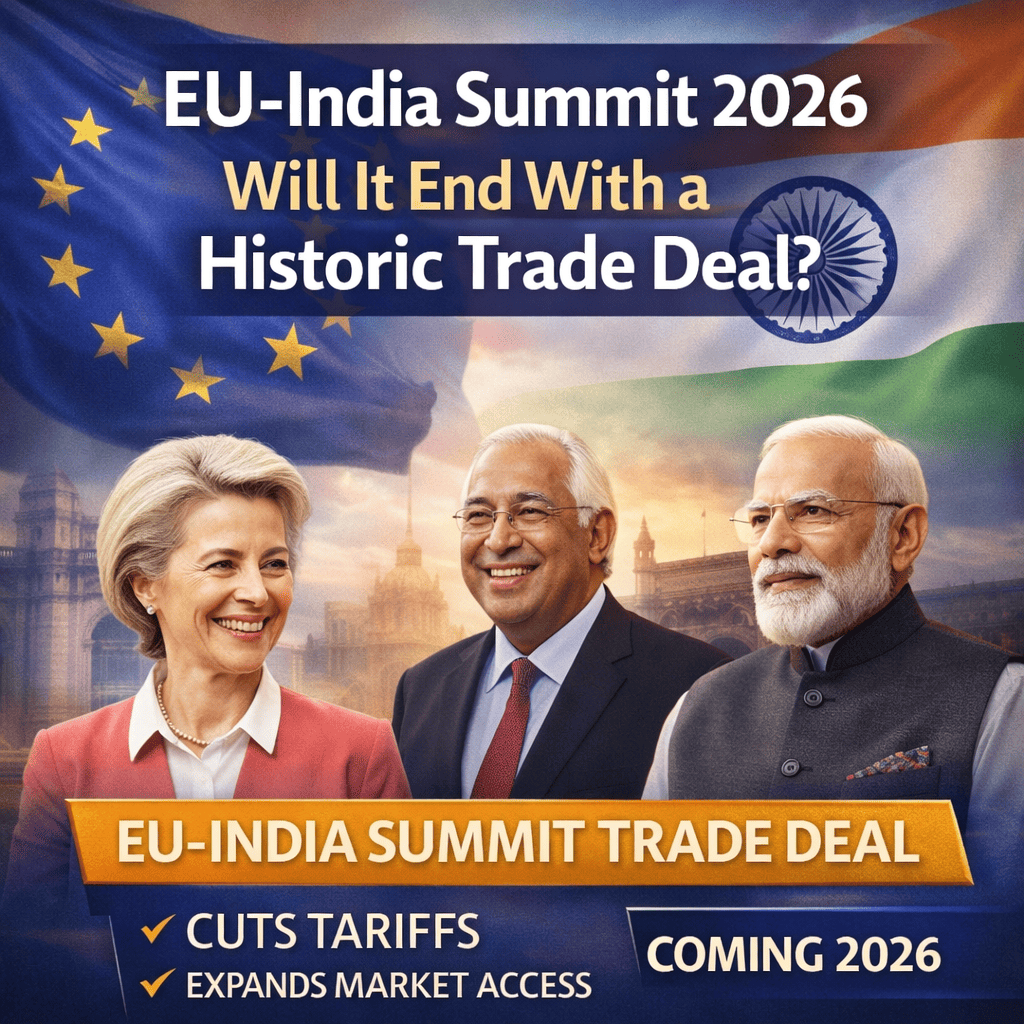
The EU‑India Summit trade deal has become the central question as European and Indian leaders meet in New Delhi, with both sides indicating that years of negotiation are close to yielding a breakthrough. Talks on a free trade agreement began in 2007, stalled for almost a decade, and resumed in 2022. Now, diplomats describe the process as largely complete, with only legal and technical steps remaining.
The scope of the EU‑India Summit trade deal reflects the scale of the relationship it aims to reshape. The European Union is already India’s largest trading partner, while India is among the EU’s fastest‑growing markets. Yet tariffs and regulatory barriers have constrained growth. European exporters face steep duties on products such as cars, wine, machinery, and chemicals. Indian manufacturers struggle with access to European markets for textiles, leather goods, seafood, and services.
At the summit, Prime Minister Narendra Modi is joined by European Commission President Ursula von der Leyen and European Council President António Costa. Their agenda goes beyond commerce. Defence cooperation, climate policy, digital infrastructure, and supply‑chain resilience feature prominently. Still, the EU‑India Summit trade deal remains the anchor, shaping expectations for everything else.
Officials on both sides frame the agreement as a response to global trade volatility. With protectionism rising elsewhere, Brussels and New Delhi see strategic value in anchoring their partnership in rules‑based commerce. The EU‑India Summit trade deal signals an intent to diversify economic dependencies rather than remain exposed to a single dominant trading power.
For European industry, the prize is access to a consumer market of more than 1.4 billion people. Automakers, luxury goods producers, and industrial equipment suppliers expect tariff reductions to translate directly into competitiveness. For India, the deal offers expanded access to European consumers and increased investment in manufacturing, logistics, and clean technology.
A friction point remains in how quickly sensitive sectors should open. India has pushed for transition periods in areas such as electric vehicles and advanced manufacturing. European negotiators accept phased liberalisation but insist on clear end‑dates. The structure of these safeguards will define the practical impact of the EU‑India Summit trade deal over its first decade.
Market reaction has already begun. Indian exporters in textiles and seafood have seen renewed investor interest, anticipating better terms in Europe. European firms are preparing for price recalibration across Indian operations. Multinationals are also reassessing supply chains, betting that the EU‑India Summit trade deal will reduce regulatory uncertainty.
If leaders announce political closure during the summit, formal ratification will still take months. That lag creates a narrow window for domestic opposition in both blocs. Farming lobbies in Europe and small manufacturers in India remain wary of competition. Managing that resistance may prove harder than concluding negotiations.
What emerges from New Delhi will determine whether the EU‑India Summit trade deal becomes a symbolic handshake or a structural shift in global trade architecture.
Also Read: India‑EU ‘Mother of All Deals’ Set to Open Indian Market to EU Companies