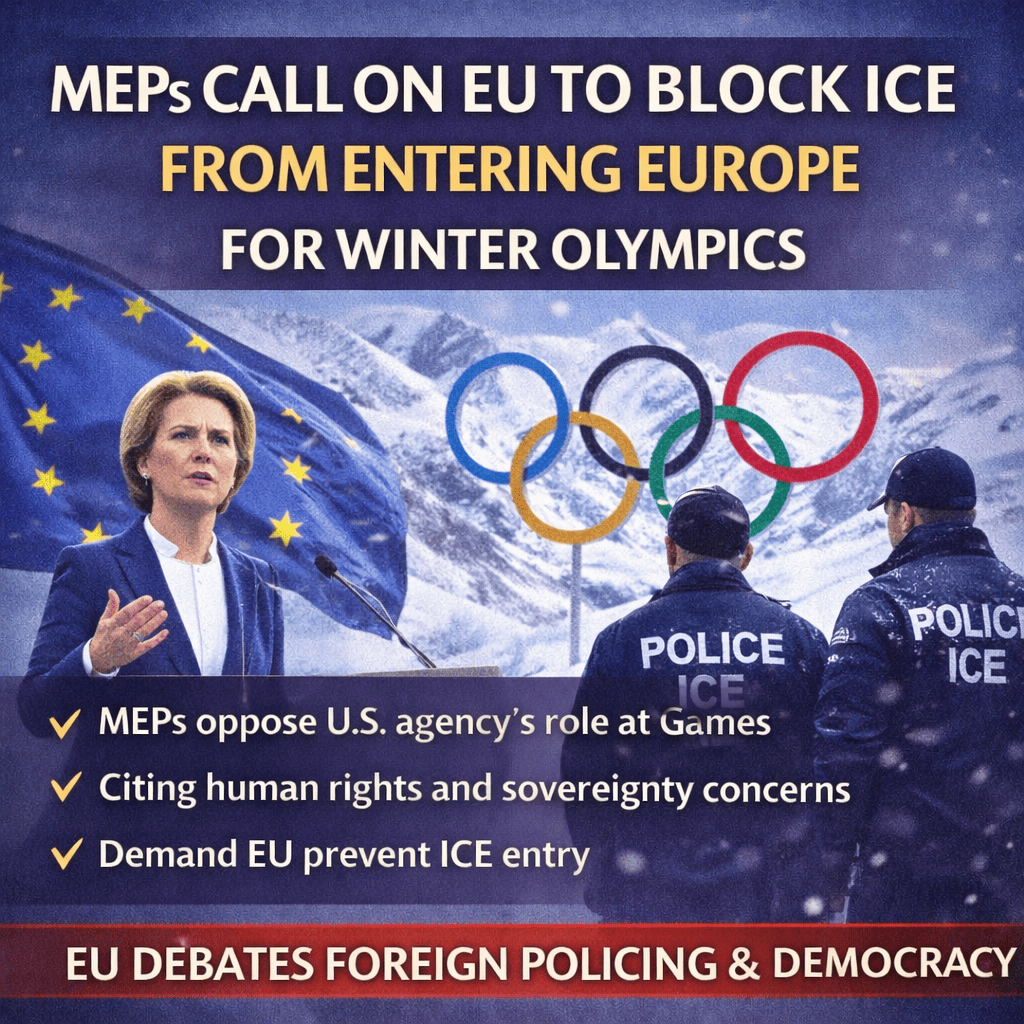
Several Members of the European Parliament are pressing Brussels to act, urging the EU to block ICE from entering Europe ahead of the Milan–Cortina Winter Olympics. Their demand centres on reports that agents from the United States’ Immigration and Customs Enforcement (ICE), particularly its Homeland Security Investigations unit, may be involved in security operations during the Games.
Lawmakers opposing the move argue that allowing ICE to operate in Europe, even in an advisory or support role, raises serious questions about sovereignty, democratic accountability, and the protection of fundamental rights. The Winter Olympics, they say, should not become a gateway for foreign law enforcement agencies whose mandates and practices fall outside EU legal frameworks.
Members of left‑wing and progressive groups in the Parliament have led the call for the EU to block ICE from entering Europe. They contend that security at major international events should remain strictly under the control of host nations and EU authorities. Any external cooperation, they argue, must be transparent, limited, and fully aligned with European law.
Critics point to ICE’s controversial record in the United States, where the agency has faced sustained scrutiny over its immigration enforcement methods and alleged abuses. For these MEPs, inviting ICE personnel into Europe risks signalling tolerance for practices that clash with EU human rights and rule-of-law standards. They warn that even symbolic involvement could undermine Europe’s credibility when it speaks on democratic values globally.
In a formal letter sent to senior EU leaders, including the European Commission president, lawmakers requested concrete steps to prevent ICE agents from entering EU territory for the Games. The letter calls for restrictive measures and stresses that public security in Europe should never be exempt from democratic oversight or judicial safeguards. According to the signatories, the EU’s decision to block ICE from entering Europe is not a diplomatic provocation but a legal necessity.
Others in the Parliament disagree. Some centre‑right and conservative MEPs argue that cooperation with international partners is standard practice for events of this scale. They insist that any ICE presence would be limited, coordinated with Italian authorities, and focused on intelligence sharing rather than enforcement. From this perspective, fears about foreign policing are overstated.
The dispute reflects a deeper divide over how Europe manages security in an increasingly interconnected world. As transnational crime and terrorism evolve, cooperation across borders has become routine. Yet the demand for the EU to block ICE from entering Europe shows that not all partnerships are treated equally.
With the Winter Olympics approaching, pressure is mounting on EU institutions to clarify whether ICE will have any role and, if so, under what conditions. The outcome could set a precedent for how Europe handles foreign security agencies at future international events—and how firmly it draws the line between cooperation and control.