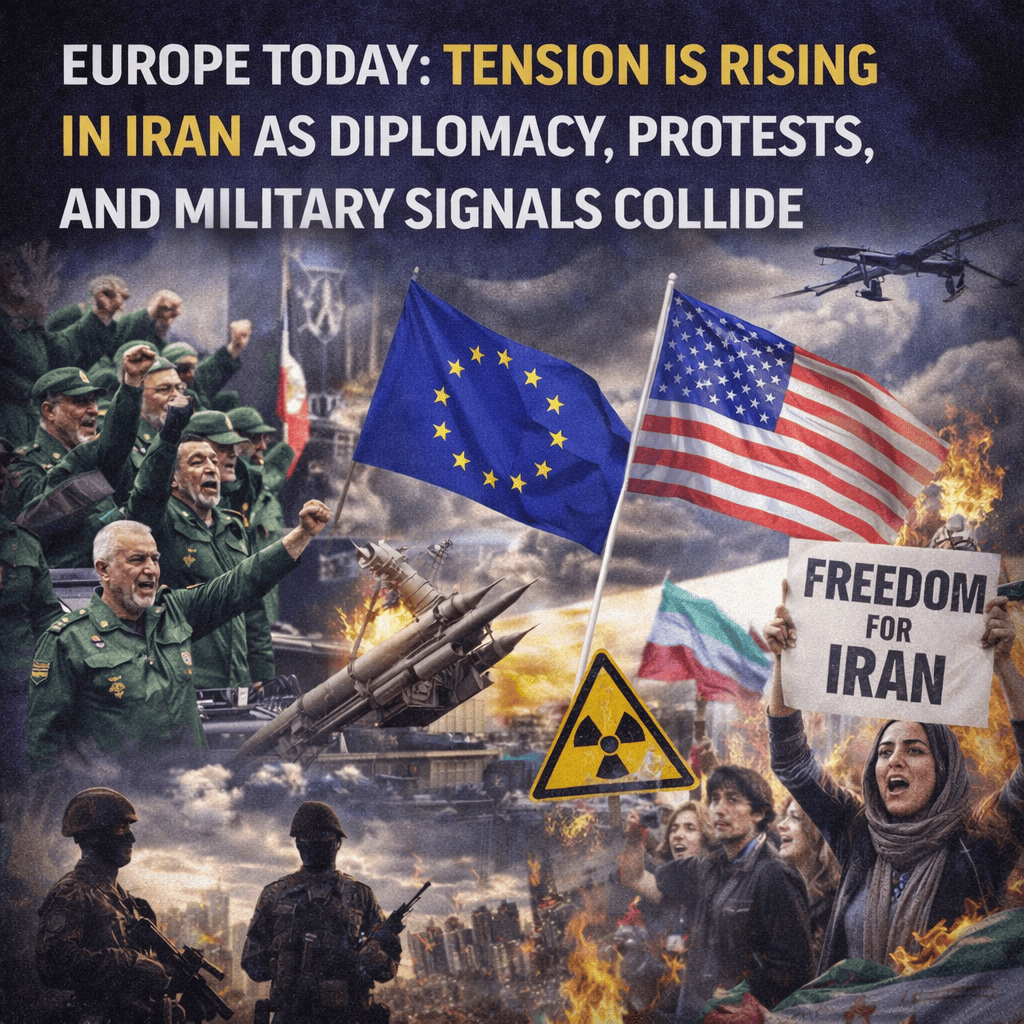
Tension is rising in Iran, driven by a sharp escalation in disputes with Europe, unresolved domestic unrest, and a fragile diplomatic track with the United States. Multiple pressure points are now reinforcing each other, narrowing Tehran’s room for maneuver and raising the stakes for regional stability.
A major trigger came after the European Union moved to designate Iran’s Islamic Revolutionary Guard Corps (IRGC) as a terrorist organisation. Tehran responded with unusually confrontational rhetoric. Iranian lawmakers staged a symbolic show of defiance in parliament, wearing IRGC uniforms and denouncing European militaries as hostile forces. The move was designed to signal resolve, but it also deepened the rift with European capitals already strained by sanctions and human rights concerns. As a result, tension is rising in Iran not only externally, but within diplomatic channels that had remained partially open.
Inside the country, political pressure continues to build. Protests that erupted over economic hardship and state repression have not fully dissipated, despite a heavy security response. Families of victims and civil society groups continue to demand accountability, while inflation, currency weakness, and unemployment amplify public frustration. Iranian officials remain concerned that renewed external pressure could reignite broader demonstrations, a fear that shapes much of Tehran’s current posture. In this context, tension is rising in Iran as leaders try to project strength without triggering further internal instability.
Relations with Washington add another layer of uncertainty. U.S. officials have maintained a hard line on Iran’s nuclear and missile programs, while keeping the door open to negotiations. Talks are expected to resume in Istanbul, but expectations are low. Iran has hinted at limited flexibility if sanctions relief becomes tangible, yet officials remain skeptical after years of stalled agreements. Any miscalculation—military or diplomatic—could quickly derail talks, reinforcing the sense that tension is rising in Iran rather than easing.
Military signaling has grown louder. Iranian commanders have declared heightened readiness in response to U.S. and Israeli movements in the region. Senior figures warn that even a limited strike would provoke a wider conflict. These statements serve a dual purpose: deterring external action while reassuring domestic audiences that the state remains in control. Still, such messaging increases the risk of escalation through misunderstanding or accident.
The economic implications extend far beyond Iran. Energy markets track developments closely, given Iran’s proximity to key shipping routes and its influence over regional supply dynamics. Even rhetorical escalation can move prices, affecting European economies already sensitive to energy shocks. For policymakers, this reinforces the need for de‑escalation mechanisms that go beyond sanctions and threats.
Possible off‑ramps exist. Expanded mediation involving regional actors such as Turkey, clearer sequencing in nuclear talks, and narrowly defined confidence‑building steps could slow the momentum. Without such efforts, tension in Iran will remain the defining feature of Europe’s engagement with Tehran—one that carries growing political, economic, and security costs.