
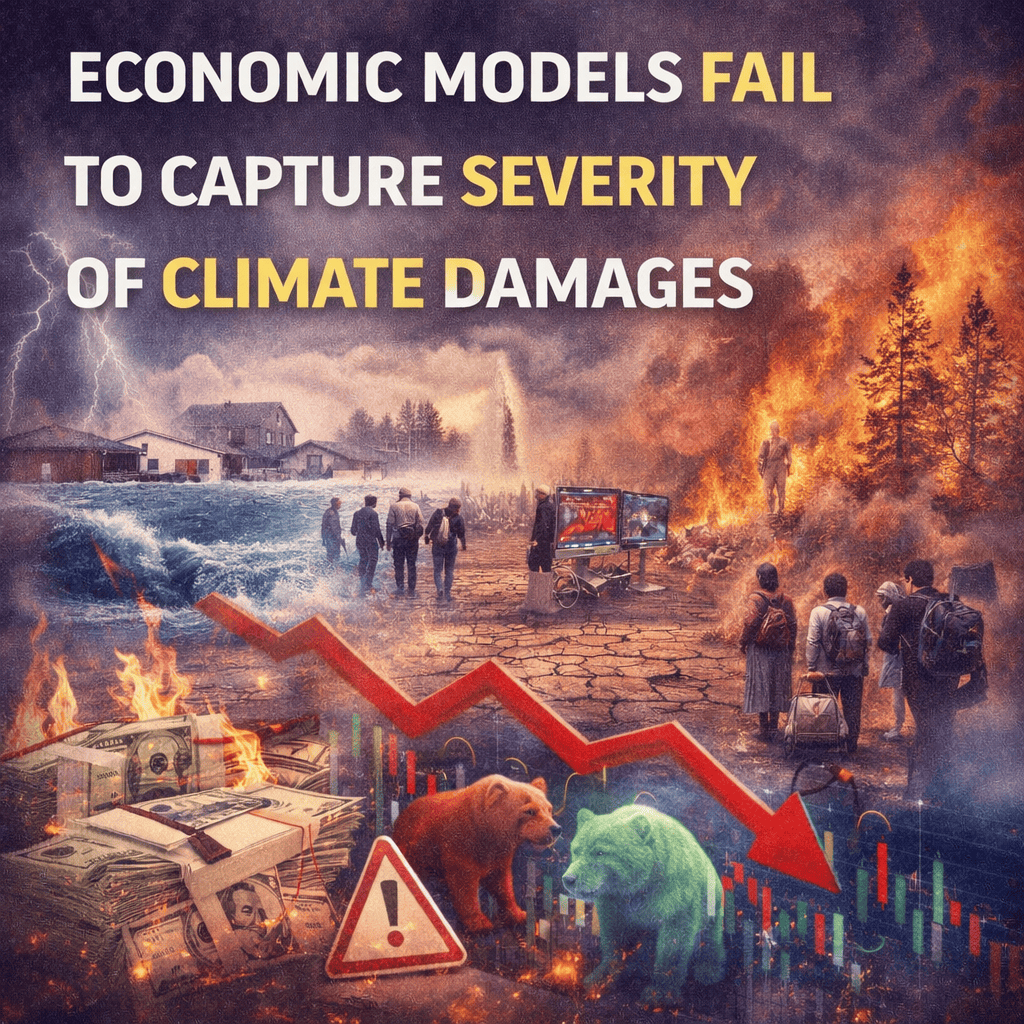
A growing chorus of scientists and economists argues that economic models fail to capture the severity of climate damages, leaving global financial systems dangerously exposed. New findings reveal that mainstream economic forecasting tools, especially those used by governments and financial institutions, drastically underplay the consequences of rising temperatures and extreme climate events.
Traditional models, including widely used Integrated Assessment Models (IAMs), typically link economic loss to slow, predictable temperature increases. These frameworks overlook how climate chaos actually unfolds—in volatile, cascading, and often irreversible patterns. This omission is not just academic. It’s influencing investment flows, infrastructure priorities, and the economic risk assessments of central banks and ministries worldwide.
In the summer of 2025, heatwaves across Europe led to crop failures, energy shortages, and public health crises. Damages were estimated at €43 billion in the short term, with multi-year costs forecast at over €120 billion. Yet many models still treat such events as anomalies rather than systemic trends.
The core problem is that most economic models ignore tipping points. Once systems—natural or artificial—cross certain thresholds, the damage doesn’t scale linearly. Glacial melt, soil collapse, mass migration, or disrupted global food chains can push financial markets into a state of shock. These high-impact, low-probability scenarios aren’t priced into current economic forecasting tools, despite being central to climate science.
Another flaw: GDP often masks destruction. A flood may boost construction figures as damaged homes are rebuilt, but that doesn’t reflect long-term productivity loss, ecological collapse, or the widening gap in inequality it causes. Standard growth metrics can mislead governments into underestimating vulnerability and overestimating resilience.
Experts warn that failing to update models means decision-makers are flying blind into a structurally unstable future. Financial regulators rely on these flawed models to assess systemic risk. If their baselines are wrong, capital could be misallocated, and global supply chains and debt markets could be left exposed to shocks they aren’t built to absorb.
To correct course, interdisciplinary solutions are being proposed. These include merging complex systems modelling with climate physics, integrating event-driven data from real-world disasters, and deploying AI to simulate nonlinear risk. There’s also growing pressure on institutions like the IMF, World Bank, and central banks to abandon outdated assumptions and begin stress-testing economies against realistic climate thresholds—not idealized temperature paths.
Until then, economic models fail to capture the severity of climate damages, which will remain a strategic blind spot—one that could undermine global economic security faster than policymakers anticipate.