
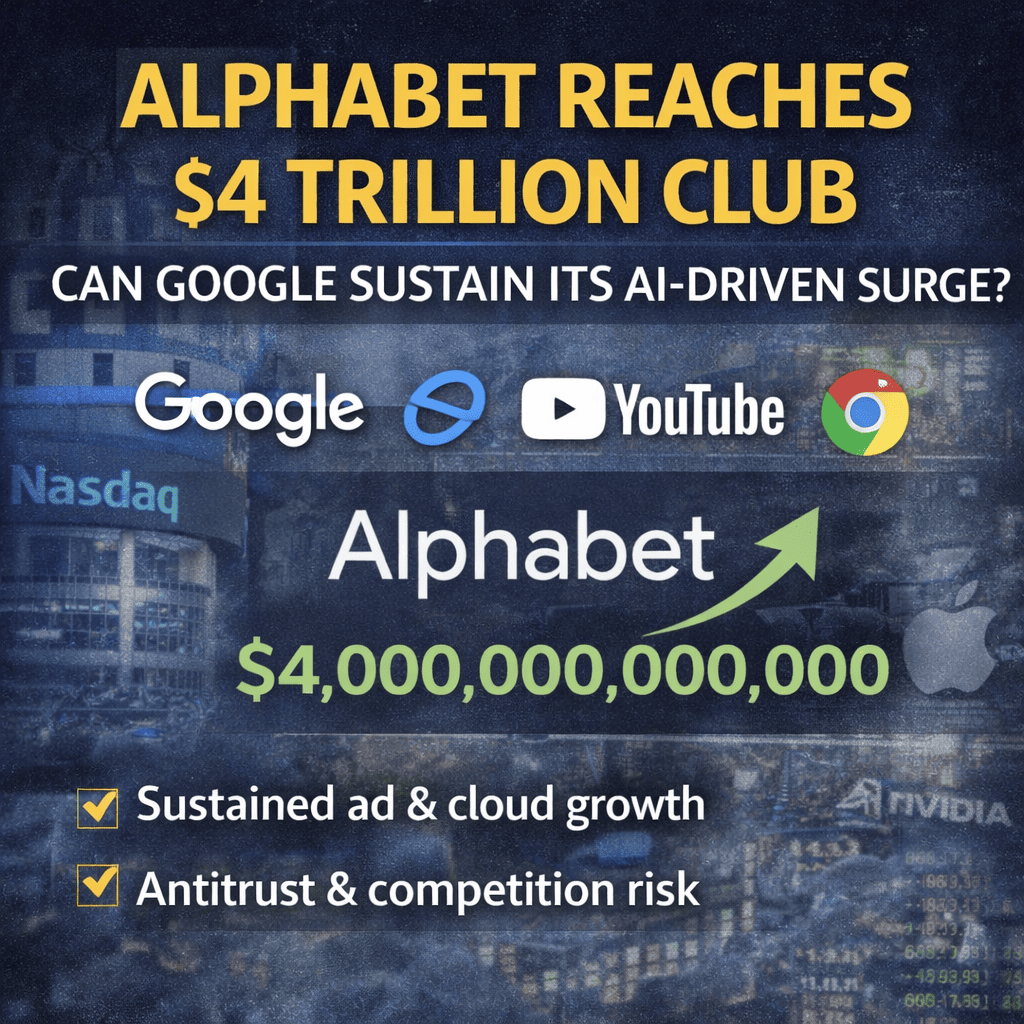
Alphabet reaches $4 trillion club after Google’s parent company surged into one of the most exclusive tiers in global markets, briefly overtaking Apple in valuation and trailing only Nvidia among the world’s most valuable firms. The milestone caps a powerful rally, with Alphabet shares up sharply over the past year as investors reprice the company as a frontline player in the AI era.
The immediate catalyst was Apple’s decision to integrate Google’s Gemini model into a major Siri upgrade—an endorsement that reframed Alphabet’s position in the AI race. For markets, it signaled that Google’s technology is not merely competitive but foundational. In a landscape shaped by OpenAI, Microsoft, and emerging search challengers, the question is no longer whether Google can defend search—it is whether it can redefine it.
Alphabet’s durability rests on three engines that compound rather than compete.
Search and YouTube remain the cash cow.
Search still anchors profit, while YouTube continues to scale as a global advertising platform. Recent results show double-digit growth in YouTube ad revenue, reinforcing the idea that Alphabet’s monetization engine remains resilient even as user behavior shifts toward short-form video and AI-assisted discovery.
Cloud is the growth narrative.
Google Cloud has become central to the valuation case. With revenue growth outpacing many peers, the unit is positioned as Alphabet’s bridge from advertising to enterprise infrastructure. AI workloads—training, inference, data pipelines—are turning cloud from a supporting business into a strategic pillar. The market’s willingness to assign a higher multiple depends on whether this growth can be sustained without eroding margins.
AI is becoming platform control.
Gemini is not just a model; it is a distribution strategy. Alphabet owns search, Android, Chrome, YouTube, and now a growing enterprise stack. The bet behind “Alphabet reaches $4 trillion club” is that Google can weave AI into every layer—consumer, creator, and enterprise—while controlling both compute and cost through its own chips and infrastructure.
The risks are structural rather than cyclical. Regulation remains an overhang. Recent antitrust rulings reduce the threat of a forced breakup, but they entrench scrutiny around data sharing, default placement, and platform power. As AI becomes more embedded in daily workflows, regulatory attention is likely to intensify rather than fade.
Valuation discipline also matters. At this scale, Alphabet must deliver not just growth, but predictable growth. Two metrics will define whether “Alphabet reaches $4 trillion club” becomes a plateau or a platform:
- Can advertising stabilize as AI reshapes how users discover information?
- Can cloud expand rapidly without compressing margins under price competition?
Speculation (flagged): If Apple deepens its Gemini integration across devices, Alphabet gains distribution leverage that rivals any platform in history. The same move, however, could invite tighter rules on default AI providers. The next phase will test whether scale remains a moat—or becomes a magnet for constraint.
Alphabet reaches the $4 trillion club on belief. Staying there will depend on execution.