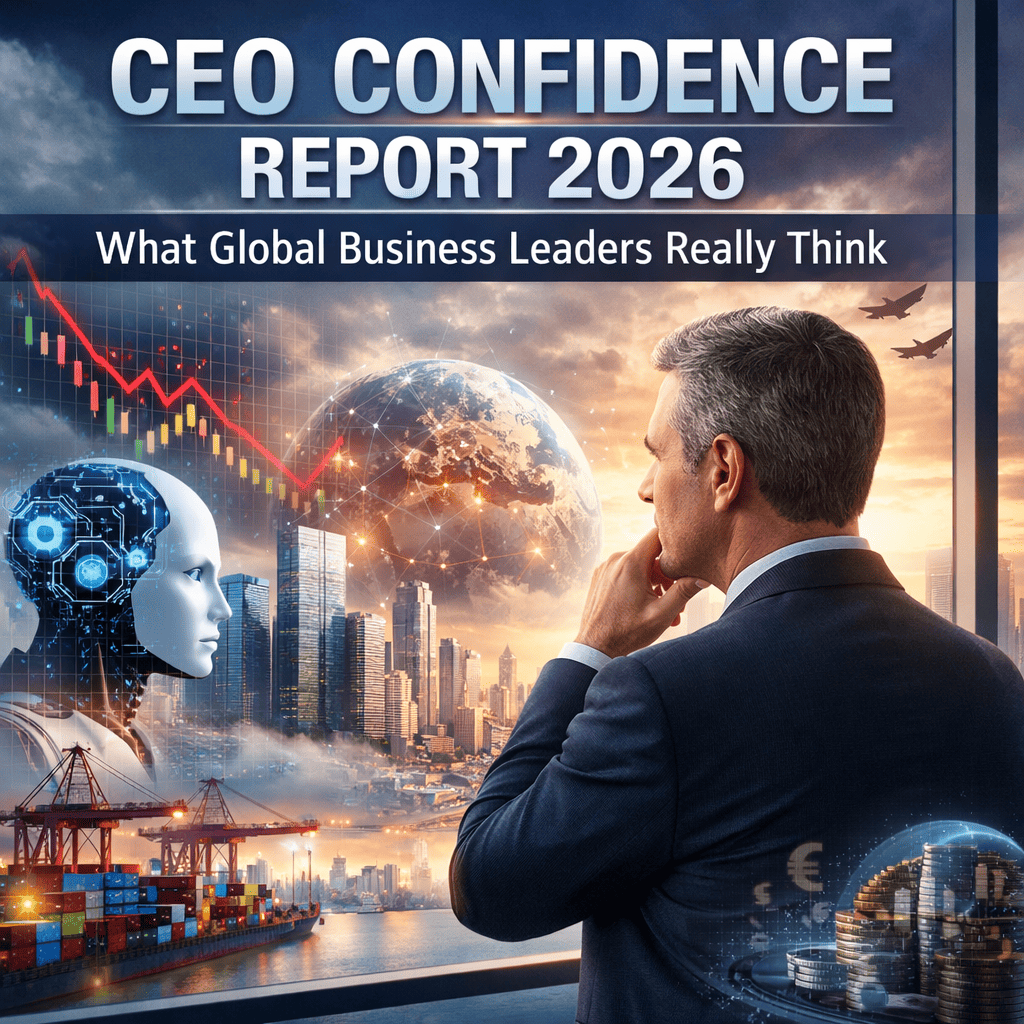
Boardrooms in 2026 feel markedly different. Not quieter because decisions have become easier, but because every choice now carries greater consequence. The CEO Confidence Report 2026 reveals a leadership landscape shaped by economic volatility, geopolitical tension, rapid AI adoption, and shifting workforce expectations.
Today’s CEOs are not simply focused on growth. They are navigating complexity at a scale unseen in previous decades. Global surveys show that while ambition remains strong, confidence has become more measured. Expansion plans are cautious. Long-term forecasts are fluid. The bold certainty of the past has given way to disciplined realism.
This is not hesitation. It is recalibration.
CEOs have not lost faith in growth. They are redefining what sustainable growth means in a world that no longer behaves predictably.
A New Shape of Confidence
Confidence in 2026 is not absolute. It exists in layers.
Leaders feel secure about their purpose and internal direction, yet unsure about the external environment. They trust their teams, but question the stability of markets, supply chains, and regulatory systems. This contrast—internal clarity paired with external unpredictability—defines modern leadership.
Instead of sweeping bets, CEOs now favor modular strategies: smaller investments, faster feedback loops, and flexibility built into every significant move. Plans are designed to adapt. Risk is distributed. Optionality is deliberate.
Confidence today is not rooted in certainty.
It is rooted in resilience.
AI: Promise Meets Reality
Artificial intelligence sits at the center of CEO sentiment in 2026. Almost every leader believes AI will reshape their industry. Far fewer believe their organization is fully prepared for that shift.
This gap between belief and readiness is where confidence weakens.
Many executives acknowledge that their AI initiatives have yet to deliver meaningful returns. Tools have been deployed. Pilot programs exist. Yet productivity gains remain uneven. The problem is rarely technical. It is structural.
Legacy systems, unclear data ownership, skills shortages, and cultural resistance slow momentum. As a result, the conversation in boardrooms has changed. CEOs speak less about “AI transformation” and more about “AI discipline.”
They are moving from experimentation to execution:
- Embedding AI into core workflows rather than side projects
- Training leaders to understand limitations, not just capabilities
- Tying AI investment to operational metrics instead of vision statements
Confidence rises when AI becomes predictable.
It fades when it remains abstract.
The most assured CEOs treat AI not as magic, but as infrastructure—something to be governed, measured, and refined.
Economic Uncertainty Becomes the Baseline
The global economy in 2026 is uneven rather than collapsing. Some regions accelerate while others slow. Interest rates stabilize in one market and spike in another. Trade relationships realign. Currency volatility returns.
What unsettles leaders is not the recession.
It is inconsistent.
Traditional forecasting models struggle to absorb sudden regulatory shifts, tariff changes, and political realignments. Many CEOs have shortened strategic horizons from five years to eighteen months.
This shift does not reflect fear. It reflects realism.
Executives now design strategies that assume disruption. They maintain liquidity. They diversify suppliers. They avoid overconcentration in any single geography. Growth remains central, but it is pursued through adaptability rather than scale.
Confidence now comes from optionality—the ability to pivot without losing momentum.
Talent and the Silent Strain on Leadership
The most underestimated factor shaping CEO confidence is people.
In 2026, attracting talent is no longer the primary challenge. Retaining belief is.
Employees expect clarity:
- Why does this company exist?
- How does my work matter?
- What future am I building here?
Hybrid work has expanded autonomy but weakened emotional attachment. CEOs sense a growing distance between leadership vision and everyday execution.
Confidence erodes when culture fragments.
The most optimistic leaders are those investing deeply in internal communication, leadership development, and career architecture. They treat culture as a strategic asset, not an HR function.
In these organizations:
- Managers are trained as coaches
- Performance reviews include purpose alignment
- Learning pathways are visible and funded
CEOs who see engagement strengthen regain momentum.
Those who watch it fade begin to question even strong financial results.
Geopolitics Enters the Strategy Core
Geopolitics is no longer background noise. It has become a board-level variable.
Trade conflicts, regional instability, and regulatory divergence now influence capital allocation. Market size is no longer enough—political trajectory matters. A factory location carries diplomatic weight. A partnership signals alignment.
This reality has reshaped how leaders define risk.
Many CEOs now maintain geopolitical dashboards alongside financial ones. They consult political analysts as frequently as industry experts. Expansion decisions involve scenario planning that once belonged to governments.
Confidence in 2026 is shaped by foresight.
Leaders who invest in intelligence—economic, political, and cultural—feel equipped. Those who rely on historical stability feel exposed.
The role of the CEO has quietly expanded.
It now includes geopolitical literacy.
From Growth-at-All-Costs to Endurance
A decade ago, confidence was fueled by speed. Market capture mattered more than margin. Expansion mattered more than efficiency.
That era is closing.
In 2026, endurance defines success.
Leaders now prioritize:
- Profitability over pure growth
- Long-term trust over short-term attention
- Operational resilience over market domination
This shift has softened bravado and sharpened judgment. CEOs speak less in slogans and more in systems. They ask how decisions compound over time.
Confidence grows when strategy, culture, and capability align.
It weakens when growth feels forced.
What the Most Confident CEOs Do
Across industries, the most self-assured leaders share common behaviors:
They simplify.
They remove complexity from operations, products, and decision paths.
They invest in clarity.
Every employee understands where the company is going and why.
They treat risk as design input.
Uncertainty shapes strategy rather than disrupting it.
They build leadership depth.
Confidence rises when decisions do not bottleneck at the top.
They measure what matters.
AI performance, engagement levels, supplier stability—nothing remains abstract.
These leaders do not deny volatility.
They design it.
The Emotional Reality at the Top
Behind every dashboard sits a human being.
CEOs in 2026 speak more openly about the pressure they face. Leadership feels lonelier. Stakeholders are louder. Employees are more vocal. Public expectations are heavier.
The myth of the invincible executive has faded.
Confidence is no longer performative.
It is internal.
Many leaders now seek peer networks, executive coaches, and private forums to process uncertainty. They recognize that clarity begins with reflection.
The strongest CEOs are not those who project certainty.
They are those who cultivate steadiness.
They ask better questions:
- What must remain stable when everything else shifts?
- Where can we afford to experiment?
- What would resilience look like five years from now?
Confidence emerges from alignment between values and action.
The Shape of Leadership Ahead
CEO confidence in 2026 is quieter than in the boom years. It is less theatrical, less aggressive, and more grounded.
Leaders are not retreating.
They are maturing.
They understand that volatility is not a phase. It is a condition. Growth remains possible, but it must be earned through discipline, adaptability, and trust.
The modern CEO no longer asks, “How fast can we grow?”
They ask, “How long can we endure—and still lead with purpose?”
That shift defines leadership now.
In a world that no longer promises stability, confidence is no longer about predicting the future. It is about building organizations capable of facing it.