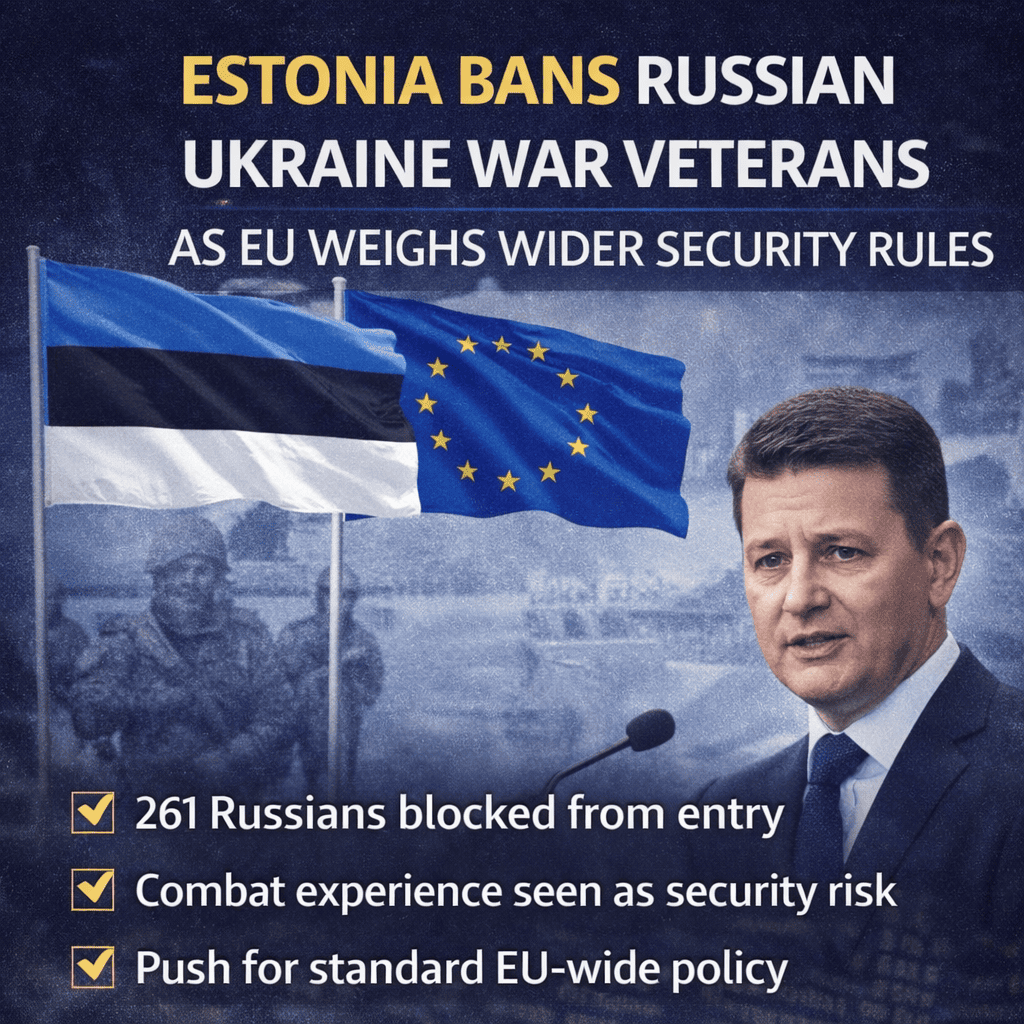
Estonia bans Russian Ukraine war veterans in a move that Tallinn says is about long-term security, not symbolism. The government has imposed an entry ban on 261 Russian citizens identified as having taken part in the invasion of Ukraine, arguing that people returning from active combat pose a risk not just to Estonia but to the entire Schengen area.
The decision is framed as a starting point. Estonian officials stress that the list will expand as more information becomes available. Foreign Minister Margus Tsahkna has urged other EU states to adopt the same principle, warning that combat experience gained in an aggressive war cannot be treated as neutral when it crosses open European borders.
Interior Minister Igor Taro has been direct about the rationale. Veterans of modern warfare return with weapons training, exposure to violence, and in some cases, links to criminal networks. For security services, that profile carries a higher risk—whether through organised crime, radicalisation, or covert influence activity. In Estonia’s view, mobility across Europe should not be automatic for individuals who took part in a war that directly threatens European security.
The political message is deterrence by exclusion. Estonia estimates that participation in Russia’s campaign runs into the hundreds of thousands. The ban signals that involvement in an aggressive war carries consequences beyond the battlefield. Ukraine has welcomed the step, describing it as a clear stance against impunity.
Estonia bans Russian Ukrainian war veterans as the conflict continues to spill beyond front lines. Ukraine reported a strike on a drone production facility in Russia’s Rostov region, with local accounts pointing to a fire at the site. The target was described as part of Russia’s drone supply chain—an effort by Kyiv to disrupt the machinery behind sustained air attacks.
In the Black Sea, two Greek-owned tankers were hit in separate incidents. Initial reports said there were no serious injuries and no significant structural damage, but the attacks underscored how shipping linked to Russian exports has become part of the strategic contest.
At the same time, Ukraine endured one of the year’s largest Russian assault waves, with strikes across multiple regions. Authorities reported deaths and damage to energy and civilian infrastructure, forcing emergency power cuts during winter conditions. The pattern reflects a campaign aimed at resilience—heat, electricity, transport—rather than only military targets.
The broader question now is whether Estonia’s ban on Russian Ukrainian war veterans becomes a European template. Tallinn’s push places a practical challenge before the EU: can member states build a shared legal and screening framework for people who fought in the war, or will measures remain national, strong in intent but uneven across borders?
For Estonia, the answer is strategic. Open borders are a strength only when risks are shared and managed collectively. The ban is meant to test whether Europe can translate that principle into action under pressure.