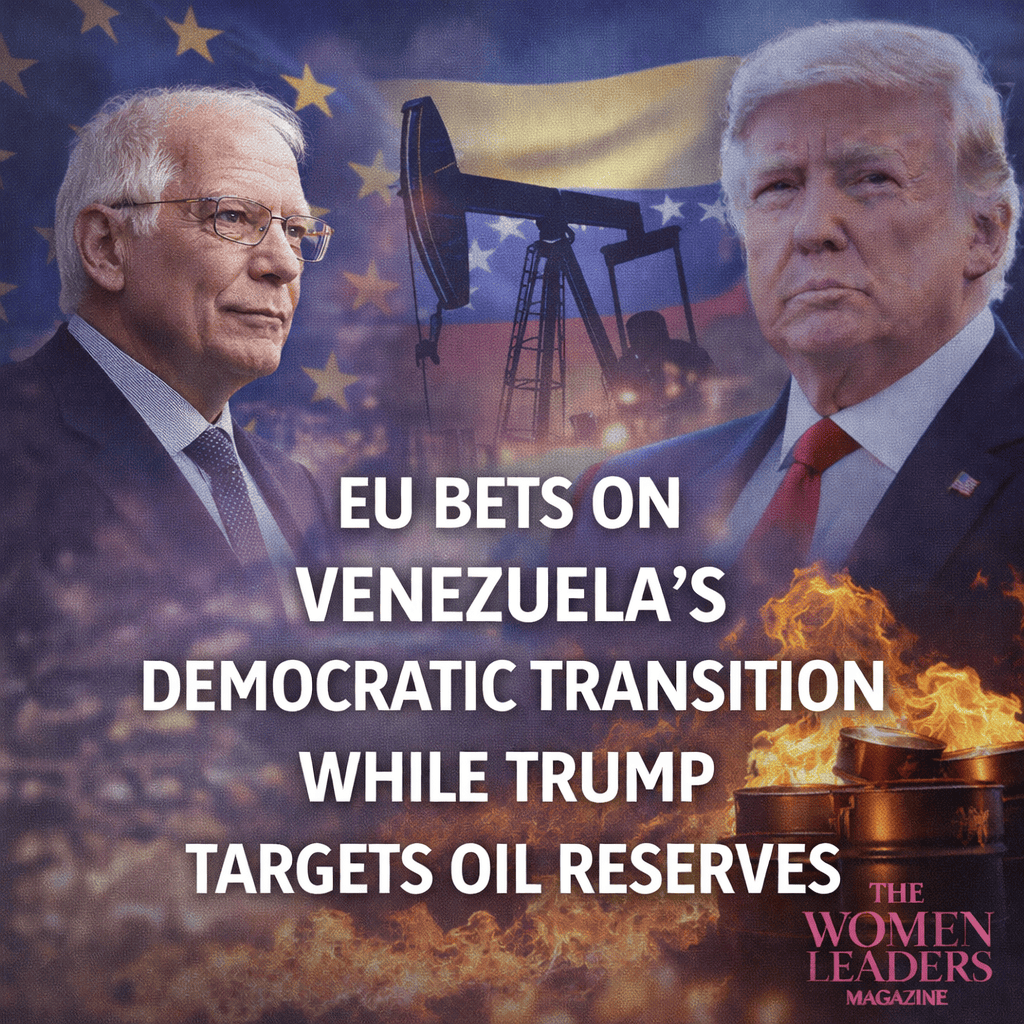
EU bets on Venezuela’s democratic transition at a moment when political change in Caracas remains fluid and international priorities are diverging. European officials are framing the post-Maduro moment as a narrow opening for a legitimate democratic pathway, even as signals from Washington increasingly centre on Venezuela’s vast oil reserves and their strategic value.
Brussels has been explicit about what it will not do. The European Commission has declined to recognise any automatic successor following Nicolás Maduro’s removal, including Vice President Delcy Rodríguez. For the EU, legitimacy cannot be inherited through internal decrees; it must emerge from a process that includes political guarantees, independent institutions, and elections that meet international standards. This stance underlines why the EU bets on Venezuela’s democratic transition rather than a rapid stabilisation that risks entrenching another contested authority.
European messaging stresses the Venezuelan agency. Officials insist that political change must be led by Venezuelans themselves and grounded in international law, particularly the UN Charter. The EU has avoided endorsing the method by which Maduro was removed, focusing instead on outcomes that can command domestic consent and external recognition. In this context, the EU’s bet on Venezuela’s democratic transition becomes both a political position and a safeguard against repeating past cycles of disputed legitimacy.
Washington’s posture points in a different direction. Public remarks attributed to Donald Trump have highlighted Venezuela’s oil wealth, reviving speculation about the rapid re-entry of US firms into the energy sector. Market reactions suggest investors interpret this focus as a signal that energy extraction and supply security could take precedence over political sequencing. This contrast sharpens the transatlantic divide: the EU bets on Venezuela’s democratic transition, while the US conversation increasingly revolves around control, access, and energy leverage.
For Europe, the risk is marginalisation. Without tools to influence the pace and structure of change, the EU could find itself sidelined as oil diplomacy accelerates. That concern explains why the EU’s bet on Venezuela’s democratic transition is paired with calls for clear benchmarks rather than open-ended optimism.
Several policy levers remain available. Conditioning diplomatic recognition on measurable steps—such as the release of political prisoners, the appointment of an independent electoral authority, and a fixed election timetable—would translate principle into leverage. Reworking sanctions toward targeted, reversible measures tied to governance benchmarks could preserve pressure while reducing harm to civilians. On the energy front, Europe could insist that any reopening of Venezuela’s oil sector be tied to transparency rules, audited revenues, and anti-corruption safeguards. (Speculation: an internationally monitored revenue framework may become a condition for large-scale reinvestment.)
Ultimately, the EU bets on Venezuela’s democratic transition because Brussels views legality and process as inseparable from stability. As oil interests re-enter the equation, Europe’s challenge will be to ensure that economic momentum does not outrun political legitimacy—turning a moment of change into another unresolved crisis.