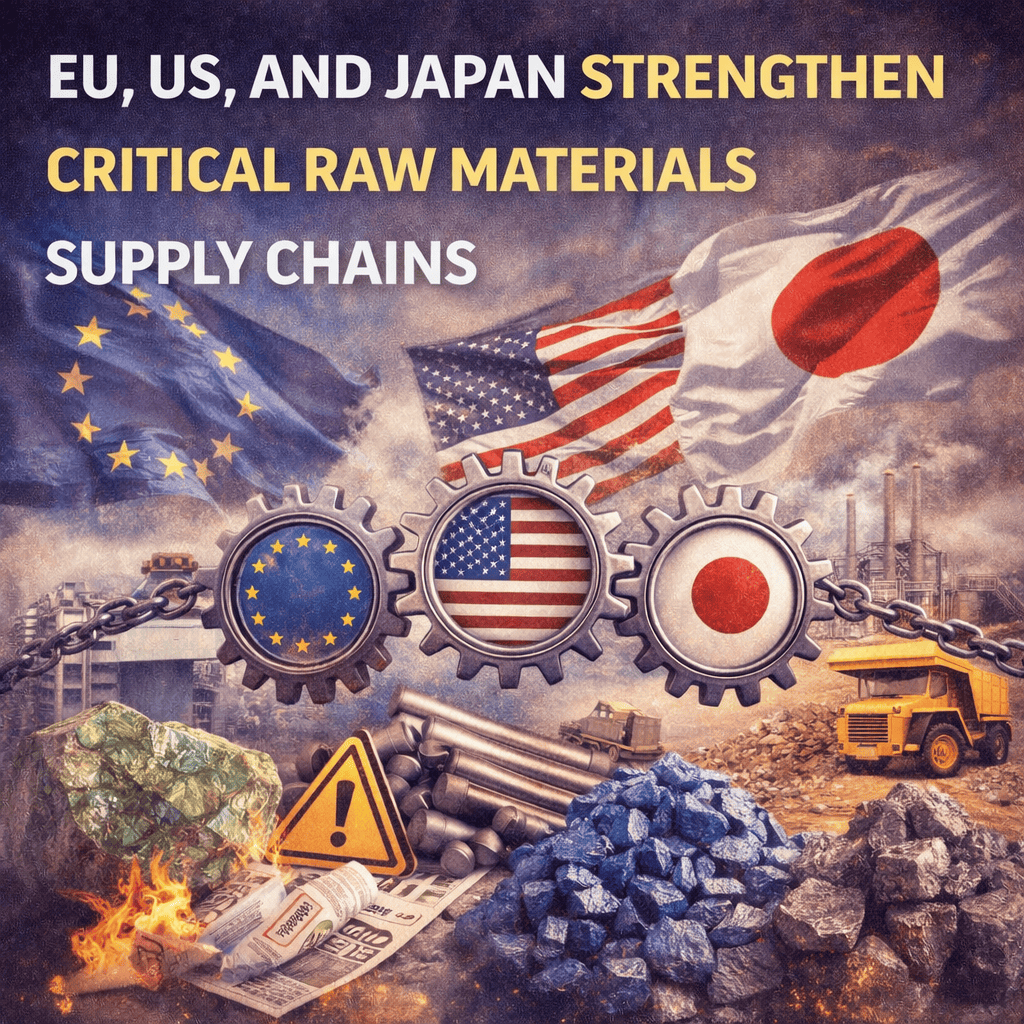
The trilateral push for cooperation on EU, US, and Japan’s critical raw materials supply chains marks a sharp pivot in global resource strategy. As access to key minerals becomes central to industrial policy, Brussels, Washington, and Tokyo are now committing to a common framework to secure the minerals essential for the energy transition, defence infrastructure, and next-gen technologies.
All three powers share the same vulnerability: overreliance on limited suppliers—especially China—for rare earths, lithium, cobalt, and other critical inputs. With resource nationalism rising and export bans now part of economic statecraft, the risk of disruption to supply chains for electric vehicles, semiconductors, and renewable power systems has become unacceptably high.
The core objective of the EU US Japan critical raw materials supply chains partnership is to diversify sourcing through investment in alternative producers across the Americas, Africa, and Australia. But beyond mining, the real leverage lies in developing refining, processing, and recycling capacity outside monopolized zones. Japan’s longstanding role in materials innovation, the U.S.’s deep capital pools, and the EU’s regulatory and market scale create a unique triangle of industrial strength.
The agreement isn’t just about volume—it’s also about standards. The three economies will coordinate environmental and labour benchmarks to ensure that new supply routes align with climate goals and ESG expectations. This alignment is designed to reduce legal risk for companies operating in sensitive jurisdictions and prevent a race to the bottom.
Policymakers also emphasize the importance of data transparency. Plans are in place to build a shared monitoring system to track supply chain risks, early warning signs of disruption, and opportunities for joint procurement or strategic reserves. This includes standardizing certification for sustainable extraction and ethical sourcing, reducing bottlenecks in procurement for automakers and electronics manufacturers.
Within the EU-US-Japan critical raw materials supply chains pact, there is recognition that private investment is stalling in the absence of long-term certainty. By coordinating subsidies, co-financing riskier projects, and harmonizing permitting rules, the three partners aim to make capital-intensive extraction and processing projects more bankable.
Technology collaboration is another focal point. New investments in battery recycling, material substitution, and circular economy innovation will be jointly supported, offering a path to reduce primary material demand over the next decade. Shared IP pools and public–private research alliances are on the table.
The broader implication is strategic: this initiative reframes raw materials from a commodity concern to a pillar of national security. Through the EU, US, and Japan’s critical raw materials supply chain plan, the world’s leading democracies are laying the groundwork for a mineral supply model that’s not only diversified but also aligned with economic and geopolitical stability.