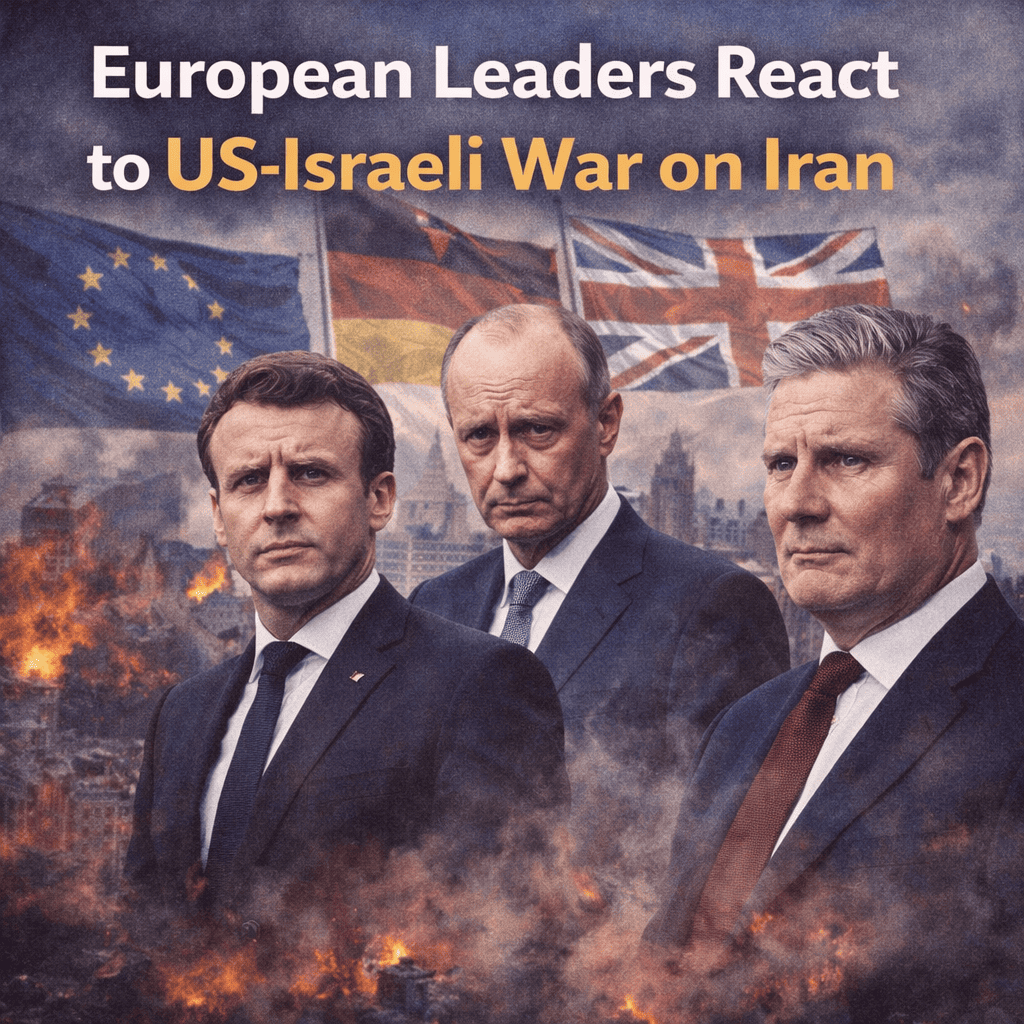
As European leaders react to the US-Israeli war on Iran, the response across the continent reflects a careful balancing act between alliance politics, regional stability, and domestic security concerns. Following coordinated U.S. and Israeli strikes on Iranian targets—and Tehran’s retaliatory missile and drone attacks—European capitals are urging restraint while preparing for potential spillover effects.
France, Germany, and the United Kingdom have taken a notably measured approach. In a joint position, their leaders stressed the need to avoid further escalation and called for immediate diplomatic engagement. While stopping short of openly criticising Washington or Tel Aviv, they avoided endorsing the military action. The emphasis instead fell on protecting civilians, preventing wider regional destabilisation, and keeping diplomatic channels open.
Berlin has underlined the importance of long-term planning beyond the immediate crisis. German officials acknowledged concerns surrounding Iran’s nuclear and missile capabilities but warned that sustained escalation could generate unpredictable consequences across the Middle East. The message from Germany signals support for security objectives paired with caution about prolonged confrontation.
Paris has simultaneously reinforced domestic security. French authorities elevated alert levels around sensitive sites, including diplomatic missions and public institutions, anticipating possible demonstrations or security incidents linked to the conflict. This reflects a broader European awareness that geopolitical shocks often generate domestic ripple effects.
In contrast, Spain’s political leadership has voiced sharper criticism of the strikes, arguing that unilateral military action risks undermining international legal frameworks. Madrid’s stance has reignited debate within the European Union about strategic autonomy—whether Europe should align closely with U.S. security decisions or assert a more independent diplomatic posture.
Across Brussels, EU officials have reiterated that diplomacy remains central to any sustainable solution. The European Union has long supported negotiated constraints on Iran’s nuclear programme. With the current escalation, European policymakers face renewed pressure to revive multilateral dialogue mechanisms, potentially working through backchannel diplomacy with regional intermediaries.
Energy markets and migration routes are also part of the equation. Several European governments are quietly assessing the implications for oil supply volatility and shipping security in the Gulf. Any disruption to maritime trade corridors would directly affect European economies, reinforcing why European leaders react to the US-Israeli war on Iran with caution rather than outright alignment.
The broader concern lies in regional spillover. Prolonged hostilities could destabilise neighbouring states, heighten proxy conflicts, and increase refugee flows toward Europe. Security agencies across the continent are coordinating intelligence-sharing to monitor potential threats.
Ultimately, as European leaders react to the US-Israeli war on Iran, their unified theme remains restraint. While acknowledging alliance commitments and regional security concerns, Europe’s primary objective appears to be containment—limiting escalation, protecting domestic stability, and reopening diplomatic pathways before the conflict expands further.