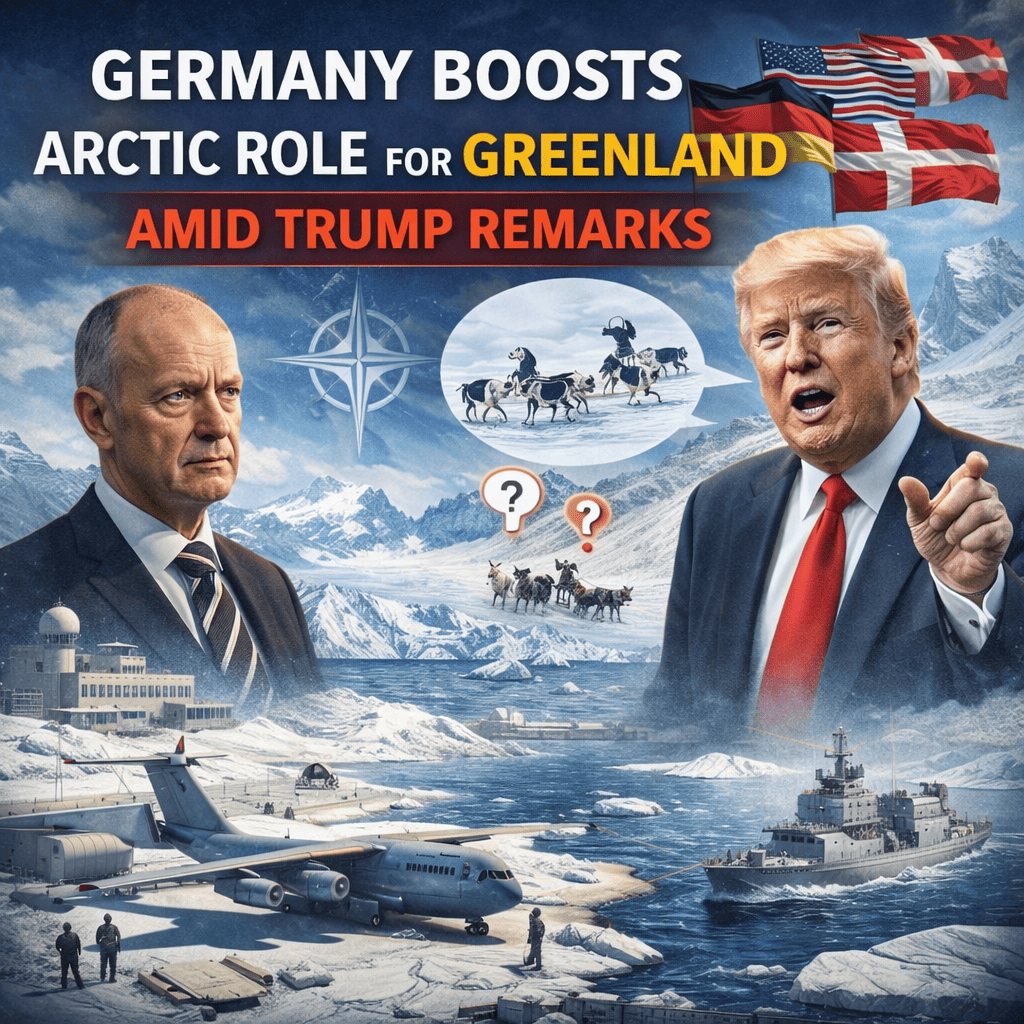
Germany boosts Arctic role for Greenland as Berlin steps forward in response to renewed comments by U.S. President Donald Trump questioning the island’s defences and repeating claims that Washington should control the territory. The remarks have sharpened debate across Europe about sovereignty, alliance responsibility, and how the Arctic should be secured as climate change reshapes access to the region.
German Chancellor Friedrich Merz said Berlin is engaged in “very detailed discussions” with Denmark on improving Greenland’s security and expects any protection to remain anchored in cooperation between the United States, Denmark, and NATO. His message was clear: Greenland’s future must be handled through alliance structures, not unilateral ambition.
Greenland, an autonomous territory within the Kingdom of Denmark, hosts a U.S. military base under existing agreements. Danish and Greenlandic leaders have repeatedly stated that the island is not for sale. Trump’s recent comments—suggesting that Greenland is defended by little more than “two dog sleds”—have been received in Europe as both dismissive and destabilising, especially at a moment when the Arctic is becoming strategically central.
Melting ice is opening new shipping routes and access to resources, while Russia and China expand their Arctic footprints. NATO Secretary General Mark Rutte has confirmed that allies are working on “next steps” to strengthen Arctic security, including options for a more structured NATO role in the region. German officials say those discussions are now active inside the alliance.
For Berlin, the logic behind “Germany boosts Arctic role for Greenland” is about preventing drift. Ambiguity inside an alliance creates space for rhetoric to become policy. Germany’s approach aims to replace speculation with coordination—ensuring that Greenland’s security is visibly collective and governed by treaties.
The shift does not imply permanent basing or militarisation. Instead, Germany is advocating measures that increase stability without provoking escalation:
- Expanded air and maritime monitoring to improve situational awareness
- Rotational allied patrols to maintain presence without permanence
- Resilience upgrades for ports, runways, fuel depots, and communications
- Joint cold-weather training to improve readiness across NATO forces
- Clear alliance messaging on sovereignty and responsibility
These steps reinforce the point that rules, not claims, govern the High North.
Germany’s growing Arctic engagement also reflects a broader change in European strategy. The region is no longer peripheral. It intersects with energy security, global trade, space infrastructure, and deterrence. Berlin’s move signals that Arctic stability is now a core European interest, not just a Nordic concern.
“Germany boosts Arctic role for Greenland,” therefore becomes more than a diplomatic response—it is a recalibration of Europe’s strategic map. By embedding Greenland’s security more deeply into NATO planning, Germany is working to ensure that the Arctic remains governed by cooperation rather than pressure, and by alliances rather than acquisition.