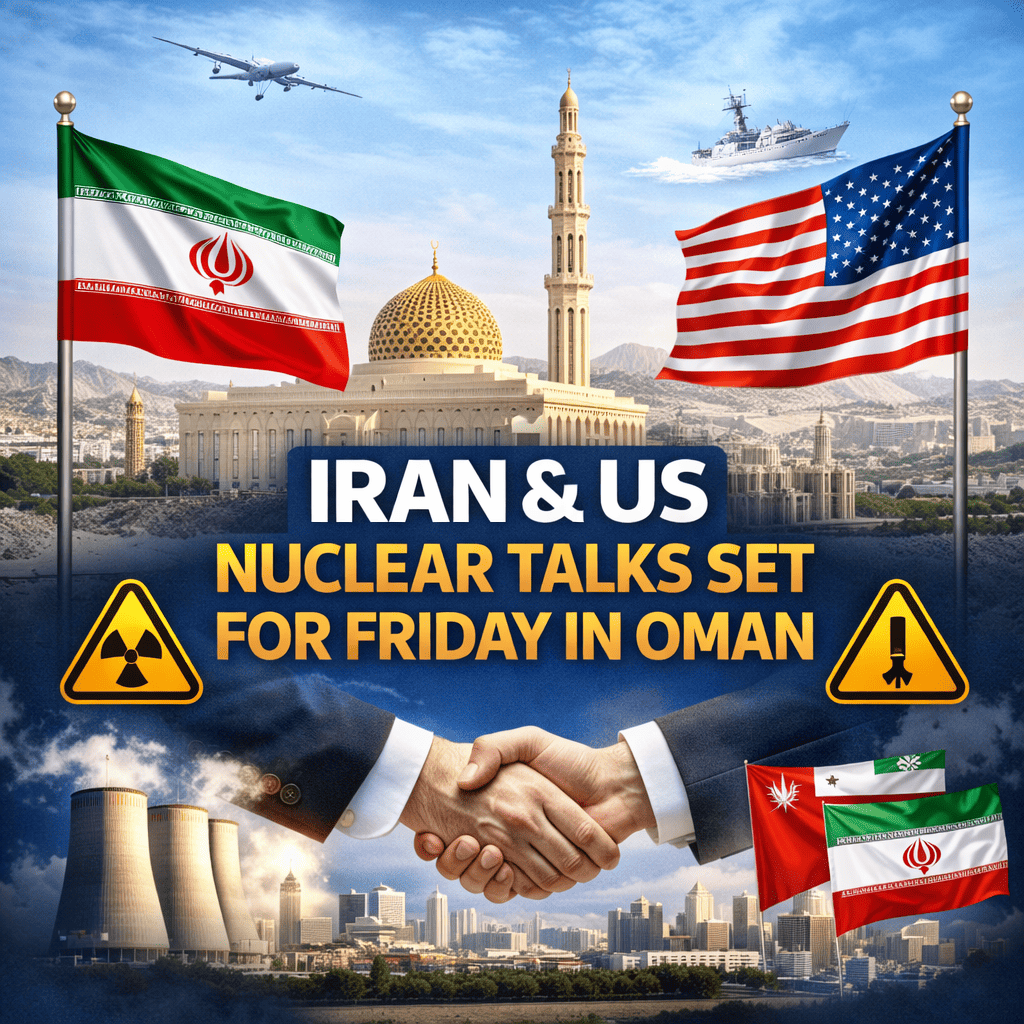
Iran’s foreign ministry has confirmed that Iran US nuclear talks in Oman will take place on Friday, following days of uncertainty over logistics and political optics. The venue shift—from Turkey to Oman—was a key condition set by Tehran and a point of initial resistance from Washington, but was ultimately accepted under pressure from Arab states and European mediators.
The decision to meet in Muscat instead of Ankara is more than symbolic. Oman has a longstanding reputation for neutrality and discreet diplomacy in Gulf affairs. Iran reportedly refused to proceed unless the talks occurred in a country it deemed politically non-aligned and historically trustworthy. For the US, Oman’s involvement was seen as limiting the scope of the dialogue, particularly on regional security and missile programs that American negotiators want to include.
The Iran US nuclear talks in Oman are unfolding in an increasingly fragile regional climate. Both sides are arriving with sharply divergent objectives. Iran wants the focus limited strictly to its nuclear program, particularly centrifuge activity and uranium enrichment thresholds. It is resisting any linkage to topics like its ballistic missile arsenal or influence in Iraq, Syria, and Yemen. The US, on the other hand, is pushing for a wider agenda that includes verification mechanisms and curbs on regional aggression.
President Trump issued a terse warning earlier this week, indicating the administration would not tolerate further enrichment advances by Iran. Military deployments in the Gulf have been quietly reinforced. Senior officials have hinted that failure in Oman could trigger more aggressive containment strategies, including economic escalation or maritime interdiction.
The Iranian side, led by Foreign Minister Abbas Araghchi, is seeking a structured, phase-based return to compliance, conditional on the easing of US-led sanctions. That includes oil exports, financial transfers, and access to global markets. US officials, however, remain skeptical of Iran’s intent and are reportedly weighing new verification protocols powered by satellite surveillance and AI-driven monitoring tools, potentially enabling near—real—time detection of violations.
As the Iran US nuclear talks in Oman approach, regional actors are actively lobbying for a breakthrough. The UAE and Saudi Arabia have signaled cautious optimism but remain wary of any deal that excludes missile constraints. Egypt has joined the calls for a comprehensive framework.
While no breakthrough is guaranteed, the Muscat meeting marks the most direct engagement between Washington and Tehran in over a year. The shift in venue, the expanded agenda, and the evolving role of Gulf nations suggest this round of diplomacy carries higher stakes—and fewer fallback options.