
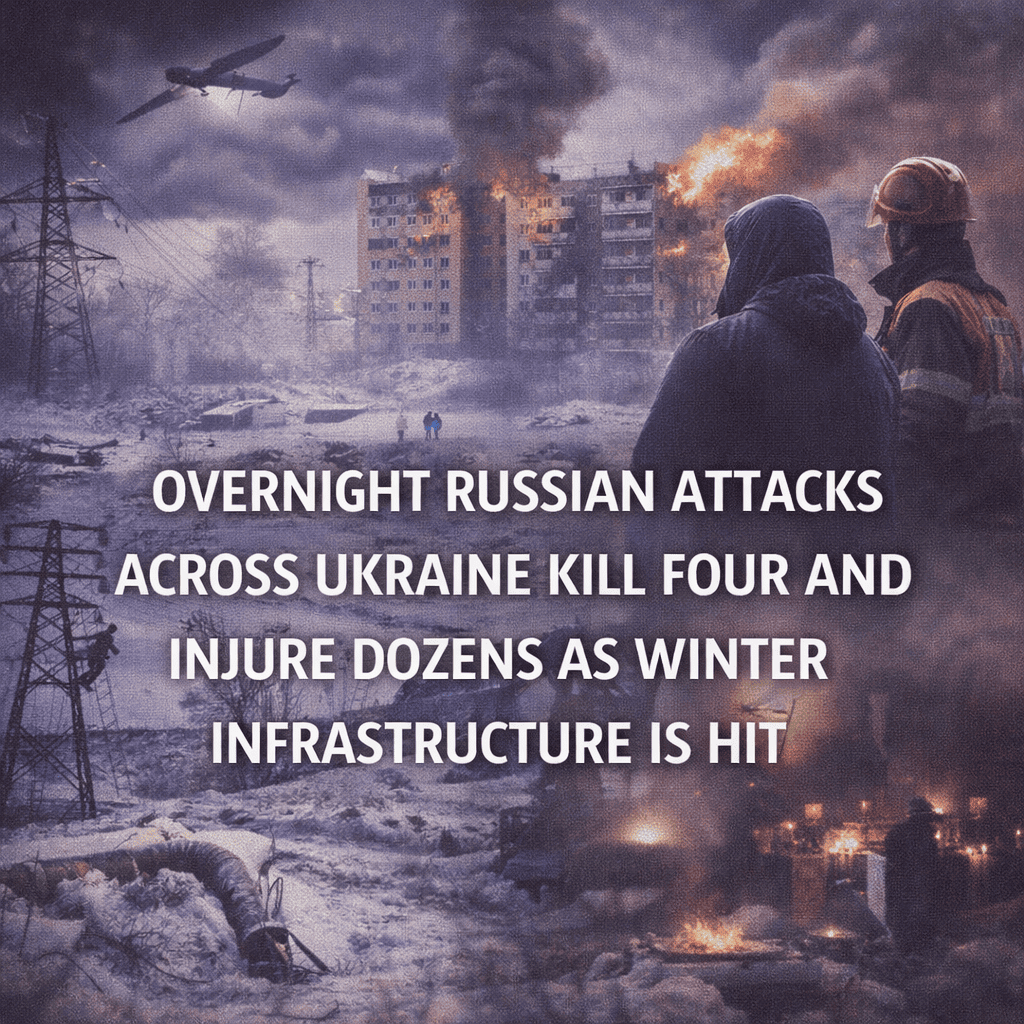
Overnight Russian attacks across Ukraine killed at least four people and left more than 20 injured after a large-scale drone assault struck cities and towns across the east and south of the country. Ukrainian authorities said Russia launched more than 150 drones toward over 20 locations, forcing air-defence systems into near-continuous operation through the night.
Ukraine’s Air Force reported intercepting most incoming drones, yet dozens still reached their targets. The pattern reflects a sustained strategy: overwhelm defences with volume, then allow a smaller number of strike drones to penetrate. The result of the overnight Russian attacks across Ukraine was a mix of civilian casualties, damaged homes, and widespread disruption to essential services.
Kharkiv, Kherson, Zaporizhzhia, and Dnipropetrovsk were among the hardest-hit regions. These areas sit close to the front lines and contain infrastructure that supports both daily life and national logistics. In Zaporizhzhia, local officials said residential neighbourhoods and energy facilities were struck, leaving hundreds of thousands of households without electricity, gas, or water during sub-zero temperatures.
Emergency crews worked through the night to restore connections. By morning, power had returned to many homes, but repairs continued across affected districts. In freezing conditions, even short outages become dangerous, especially for older residents and families with children. The overnight Russian attacks across Ukraine turned routine winter vulnerability into an acute humanitarian risk.
President Volodymyr Zelenskyy accused Moscow of deliberately targeting civilian infrastructure during cold weather to amplify suffering. He described the strikes as part of a broader escalation, noting a sharp increase in drones, guided bombs, and missiles used against cities over the past week. The timing suggests an effort to test both air defences and public endurance.
The operational logic is visible. Saturation attacks stretch interceptors and radar coverage, while infrastructure hits slow recovery and impose cumulative costs. Countering the impact of overnight Russian attacks across Ukraine, therefore, extends beyond intercepting drones. High-return measures include rapid-deploy microgrids for hospitals and heating plants, distributed backup generation for water and telecom networks, and pre-positioned repair kits that allow utilities to restore service within hours rather than days. These steps reduce the leverage of winter attacks even when some strikes get through. (Forward-looking assessment.)
The conflict also spilled across borders. Russian officials reported a fatality and injuries in the city of Voronezh after debris from a Ukrainian drone strike damaged homes and a school. The crossfire underscores how air campaigns now carry risk well beyond front lines.
For civilians, the overnight Russian attacks across Ukraine translate into darkness, cold, and fear. For policymakers, they sharpen a strategic choice: treat winter infrastructure defence as an emergency response, or elevate it to a core theatre of the war. The difference lies in whether resilience is improvised after each strike—or engineered in advance.