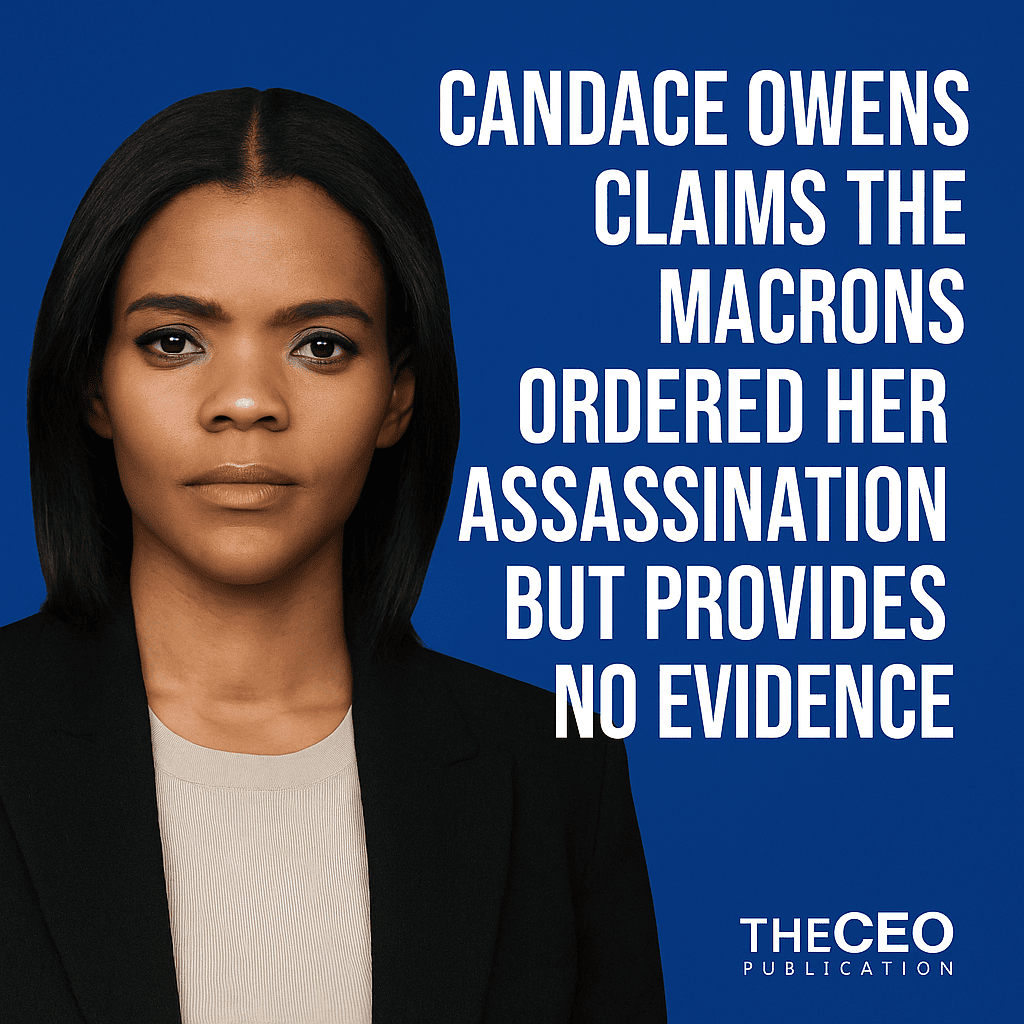
Conservative commentator Candace Owens published a viral post on X on 22 November alleging that Emmanuel Macron and Brigitte Macron ordered a professional assassination squad to kill her. She stated that a “high-ranking French government source” privately warned her of a contracted hit team and linked the alleged plot to the killing of US conservative activist Charlie Kirk. Despite the scale of the accusation, Owens claims the Macrons ordered her assassination but provides no evidence to support any part of the narrative.
Her allegations, which quickly surpassed 10 million views, came months after the Macrons filed a defamation lawsuit against her in Delaware. That lawsuit followed Owens’ repeated claim that Brigitte Macron is “secretly male,” a theory widely debunked in mainstream media. The new assassination allegation intensifies the legal and political fallout surrounding that ongoing case.
French officials have not responded publicly to Owens’ assassination claim, but media reports note that no law-enforcement agency in France, the US, or the EU has confirmed receiving credible information to substantiate it. Independent journalists and fact-checkers reviewing the posts say Owens has offered no documents, recordings, transaction data, or corroborating testimony. For this reason, coverage continues to emphasize that Owens claims the Macrons ordered her assassination but provides no evidence.
Commentators across Europe and the US warn that such claims, when amplified without verification, carry significant reputational, diplomatic, and legal risks. With the defamation case already underway, lawyers following the case suggest the new allegation could be incorporated into the Macrons’ suit, strengthening arguments of reckless disregard for the truth.
The controversy also illustrates the broader challenge of influencer-driven misinformation. High-reach public figures can shape global narratives instantly, even when their claims lack substantiation. Analysts argue that cases like this highlight the need for stronger cross-border defamation standards and more explicit platform rules around evidence requirements for extreme allegations. Others propose voluntary disclosure protocols for high-impact political commentary — such as making source material available to independent auditors.
Until Owens presents verifiable proof, the position of major media outlets remains unchanged: Owens claims the Macrons ordered her assassination but provides no evidence supporting the assertion.