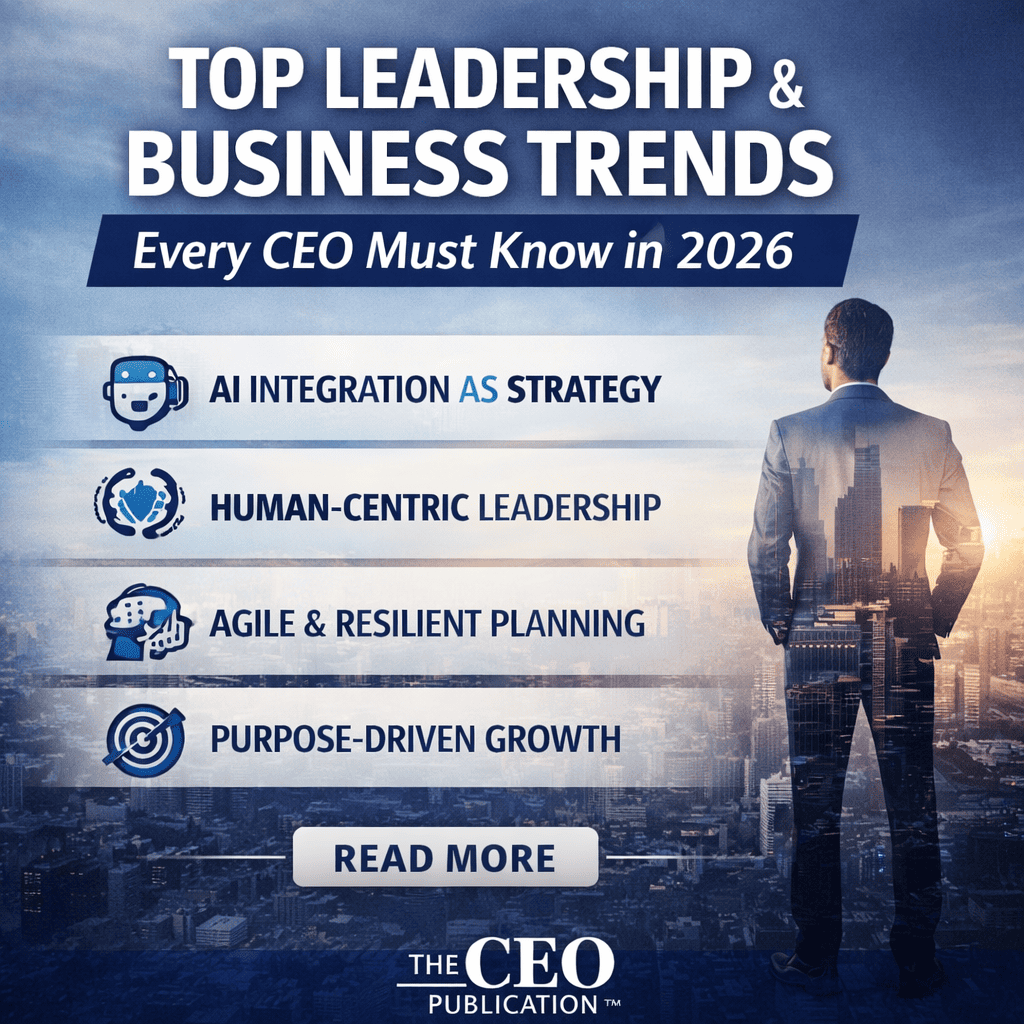
In 2026, the business landscape is shifting more rapidly than ever. Global CEOs are facing extraordinary challenges—technological disruption, workforce transformation, climate urgency, and geopolitical instability. To lead effectively in this new environment, it’s no longer enough to rely on traditional leadership models. Today’s executives must blend strategic thinking with emotional intelligence, digital fluency with human-centric leadership, and agility with purpose.
Let’s explore the top leadership and business trends in 2026 that every CEO must be prepared for to lead with confidence and drive meaningful impact.
1. AI Integration Is Now Strategic, Not Optional
Artificial Intelligence (AI) has evolved from a futuristic buzzword to a strategic imperative. In 2026, the real challenge for CEOs is not whether to adopt AI, but how to integrate it meaningfully into their core business functions.
A recent PwC survey reveals that 56% of companies are not getting measurable value from their AI investments, often due to misaligned goals and poor implementation. To avoid this trap, CEOs must focus on:
- Embedding AI into business strategy, not just operations
- Prioritizing data infrastructure and AI literacy across leadership teams
- Creating an “AI + Human” work model instead of full automation
Leaders who treat AI as a growth engine—rather than just an automation tool—will gain a competitive edge in product innovation, customer experience, and efficiency.
2. Human Leadership Skills Are a CEO’s Secret Weapon
In the age of AI and automation, human leadership traits are more valuable than ever. CEOs must lead with empathy, communication, adaptability, and emotional intelligence. The modern workforce, especially Gen Z and millennials, expects leaders who are relatable, transparent, and inspiring.
A recent leadership study identified “empathy” and “agility” as the top skills CEOs need in 2026. Companies with emotionally intelligent leaders report higher employee engagement, lower turnover, and stronger brand loyalty.
Investing in executive coaching, psychological safety, and leadership development for yourself and your top team is now a strategic priority.
3. Agility and Scenario Planning Are Replacing Static Strategy
The days of static five-year plans are over. With uncertainty becoming the new normal, CEOs must adopt agile strategy cycles, regularly reviewing and adapting plans based on real-time data and changing market signals.
Key trends include:
- Quarterly strategy reviews instead of annual ones
- Cross-functional “war rooms” for rapid response planning
- Scenario-based modeling for geopolitical, climate, and tech risks
Leading organizations now treat agility as a capability—not a crisis response. CEOs must empower teams to pivot quickly while maintaining clarity about the long-term vision.
4. Purpose-Driven Leadership Drives Growth and Loyalty
In 2026, customers, investors, and employees expect companies to stand for something greater than profit. Brands with a clear purpose and values outperform those without. Purpose-driven companies see:
- 30% faster growth
- Higher customer loyalty
- Stronger employee engagement
As a CEO, your leadership narrative matters. Define and communicate your company’s “why”, and integrate it into operations, hiring, and marketing.
Notable examples like Patagonia, Unilever, and Microsoft are showing how purpose and profit can align—especially in a world where ESG and sustainability are front and center.
5. Workforce Transformation: Hybrid, Flexible, and Empowered
The future of work in 2026 is hybrid by default and flexible by design. CEOs must redesign employee experiences around autonomy, well-being, and collaboration.
Top trends include:
- Asynchronous work models for global teams
- Results-focused performance management, not hours logged
- Continuous reskilling and internal mobility programs
CEOs are also being held accountable for mental health initiatives, diversity & inclusion, and equitable access to leadership roles. The best leaders are those who actively shape workplace culture, not delegate it.
6. Strategic Technology Investment Is a Leadership Mandate
Digital transformation is no longer an IT project—it’s a C-suite responsibility. CEOs must lead technology adoption by aligning it with business goals, customer expectations, and long-term vision.
Key focus areas:
- Cloud migration and data interoperability
- Cybersecurity governance led by the board
- AI-powered analytics for predictive decision-making
Smart CEOs also recognize that digital literacy across the leadership team is essential. If your executives don’t understand tech, your strategy will suffer.
7. Leadership Is Decentralizing: Strategy Is Everyone’s Job
In 2026, successful organizations are flattening hierarchy and pushing decision-making closer to the edge. This requires developing strategic thinking capabilities across all levels—not just the top.
Harvard Business Review emphasizes that “strategy is now a team sport.” CEOs must cultivate:
- Distributed leadership models
- Empowered cross-functional teams
- A culture where experimentation is encouraged
This shift means your executive team needs to focus less on command-and-control and more on facilitating collaboration, innovation, and ownership.
8. Sustainability and Resilience Are Core Business Priorities
Climate change, resource scarcity, and environmental regulation are pressing issues for CEOs in 2026. But rather than viewing sustainability as a compliance task, leading organizations treat it as a strategic opportunity.
Sustainable businesses attract better talent, reduce costs through efficiency gains, and appeal to investors seeking long-term value.
Resilience also plays a huge role—whether through supply chain diversification, ESG reporting, or climate risk planning. CEOs who embed resilience thinking into corporate strategy will lead more future-proof organizations.
9. Board and Stakeholder Expectations Are Rising
Today’s boards are more active, diverse, and demanding than ever. CEOs must demonstrate transparency, measurable impact, and accountability to multiple stakeholders.
From quarterly ESG metrics to CEO activism on social issues, leadership in 2026 involves more scrutiny and more responsibility. CEOs must balance:
- Investor returns
- Employee satisfaction
- Social and environmental responsibility
Navigating these expectations with confidence requires strong stakeholder communication and governance skills.
Final Thought: The CEO of 2026 Is a Human-Centered, Tech-Empowered Strategist
Leadership in 2026 is no longer about controlling everything from the top—it’s about orchestrating transformation across your organization. The most effective CEOs will be those who can connect:
- Purpose with performance
- AI with human skills
- Agility with long-term vision
- Culture with strategy
As we move through this decade of disruption, your ability to lead with clarity, compassion, and curiosity will define your success. The time to evolve is now.