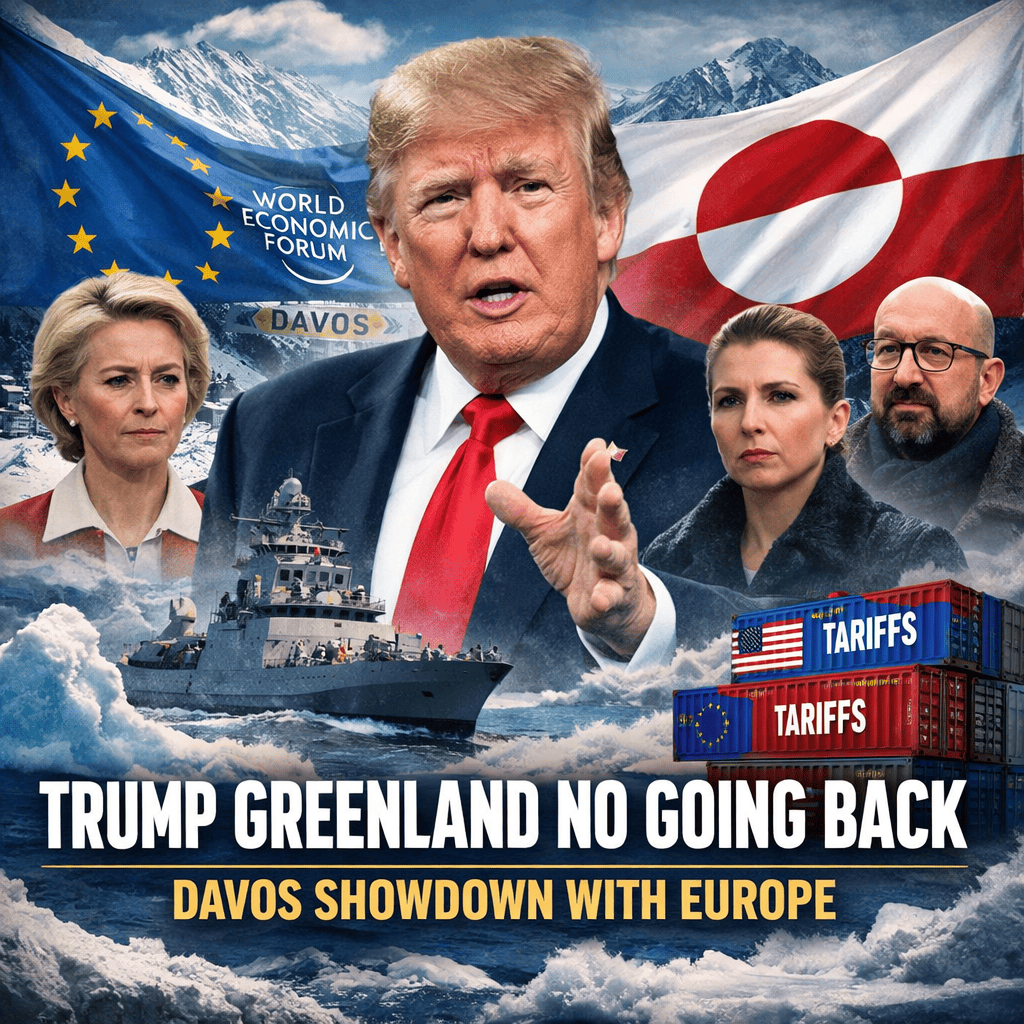
The phrase “Trump Greenland no going back” has become the defining line of a widening transatlantic rift. Arriving in Davos for meetings with European leaders, Donald Trump made it clear that the United States will not retreat from its Greenland stance. The message is blunt: this is no longer a trial balloon or a campaign-era provocation. It is policy.
Trump framed Greenland as a strategic necessity, tying the island’s future to Arctic security, shipping routes, and great-power competition. While he ruled out the use of military force, he insisted that negotiations with Denmark must begin “immediately.” For European leaders, the tone matters as much as the substance. “Trump Greenland no going back” reads less like an opening bid and more like a pressure tactic backed by economic leverage.
That leverage is evident in the tariff threats now circling the Greenland dispute. European officials view the pairing of sovereignty claims with trade pressure as coercive diplomacy. The response has been measured but firm: Brussels has slowed work on transatlantic trade initiatives and begun outlining countermeasures. The signal is that Europe will not trade territory for tariff relief.
The clash has also exposed a structural weakness in Europe’s playbook. Loud statements and symbolic unity are not enough when faced with a leader who treats brinkmanship as a negotiating style. If “Trump Greenland no going back” is meant to collapse the debate into a binary choice, Europe needs a strategy that widens the field again.
Three moves can do that.
First, separate security from sovereignty. A joint Arctic security framework—expanded basing rights, shared surveillance, and investment in dual-use infrastructure—can address Washington’s stated concerns without touching ownership. It reframes the issue from acquisition to access.
Second, replace theatrical retaliation with calibrated leverage. The EU’s Anti-Coercion Instrument works best when it is predictable. Publish thresholds, timelines, and sectoral scopes in advance. Make escalation legible. The goal is deterrence, not spectacle.
Third, center Greenlanders. Shifting the narrative toward self-determination undermines the optics of a US-EU power contest and restores agency to the people who live there. It also gives Denmark and Greenland a stronger diplomatic hand.
Markets and allies are watching whether “Trump Greenland no going back” is a fixed end-state or a bargaining posture. If tariffs remain the main instrument, Europe is likely to respond through institutions—trade committees, ratification freezes, regulatory friction—rather than consumer bans. That keeps escalation controllable while testing Trump’s willingness to trade certainty for concessions.
Davos was meant to be a reset for transatlantic confidence. Instead, it has become a proving ground for whether Europe can turn resolve into structure—and whether Washington’s hardest line still leaves room for an off-ramp.