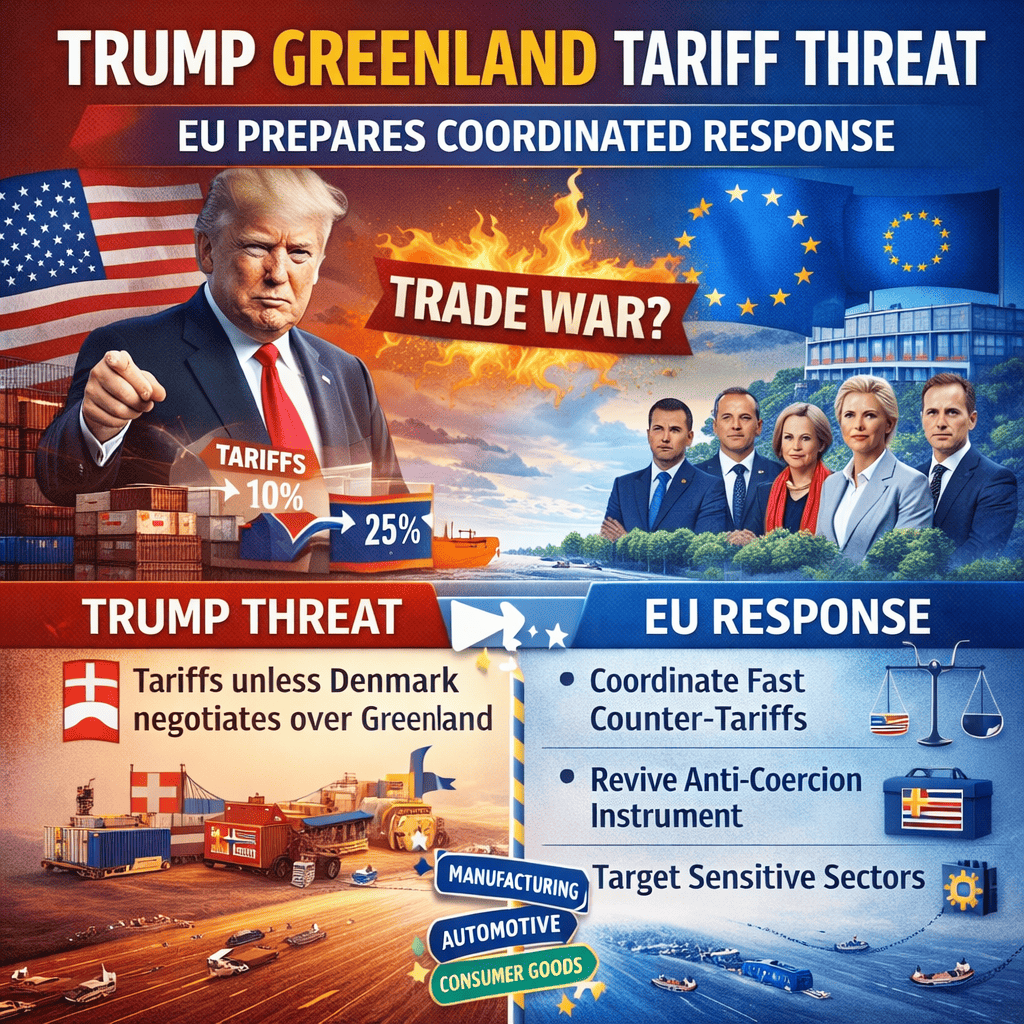
The Trump Greenland tariff threat has forced Europe into crisis-management mode. After President Donald Trump warned of sweeping new tariffs unless Denmark agrees to talks over the sale of Greenland, EU leaders signaled they will act together if Washington follows through. European Council President António Costa said the response would be coordinated across capitals, while Commission President Ursula von der Leyen cautioned that tariff escalation risks a damaging spiral in transatlantic relations.
The warning from Washington targets imports from a group of European countries closely aligned with Denmark. The White House indicated that an additional 10% tariff could take effect from early February, with the rate rising sharply in the months that follow if “no deal” is reached over Greenland. The move reframes a geopolitical dispute as a trade weapon, a shift that European officials see as coercive rather than commercial.
For Brussels, the Trump Greenland tariff threat lands on already fragile ground. The EU and the US only recently stabilized trade ties after years of dispute. European officials now face the prospect that new duties could pile on existing measures, hitting exporters of manufacturing, machinery, automotive components, and consumer goods. The political message matters as much as the economic cost: linking tariffs to territorial demands challenges core assumptions about alliance behavior.
European leaders have hardened their tone. France’s president warned that Europe will not be intimidated. Nordic governments rejected what they describe as economic blackmail. The emphasis is unity—no bilateral side deals, no fragmented responses. The aim is to deny Washington the leverage that comes from exploiting internal EU divisions.
The Trump Greenland tariff threat has also revived interest in the EU’s most powerful trade defense: the anti-coercion instrument. Adopted in 2023, it allows the EU to respond when trade pressure is used for political ends. Unlike classic retaliation, it reaches beyond tariffs into market access. The EU can restrict participation in public procurement, tighten licensing regimes, limit access to services, and apply targeted trade measures. In Brussels, lawmakers argue that this is precisely the scenario the tool was designed for.
A coordinated EU response is likely to unfold in layers. First, rapid counter-tariffs to signal resolve and maintain political symmetry. Second, if pressure persists, the selective use of the anti-coercion instrument to raise costs in areas that matter politically inside the United States, while limiting damage to European consumers and supply chains.
What boards and trade leaders should do now in response to the Trump Greenland tariff threat:
- Model stacked-duty scenarios across SKUs and regions to identify margin cliffs and contract breakpoints.
- Map exposure beyond tariffs—public procurement, certifications, data localization, and services licensing may become targets.
- Pre-build alternative routing and origin documentation; country-specific targeting is explicitly on the table.
- Prepare customer-facing playbooks for price adjustments and delivery shifts within weeks, not quarters.
Speculation (flagged): if tariffs are imposed, Europe will likely split its playbook—fast, visible retaliation for deterrence, followed by slower, higher-impact measures under the anti-coercion framework aimed at politically sensitive sectors. The Trump administration’s Greenland tariff threat may be the first real test of whether Europe’s new trade doctrine can translate unity into leverage.