
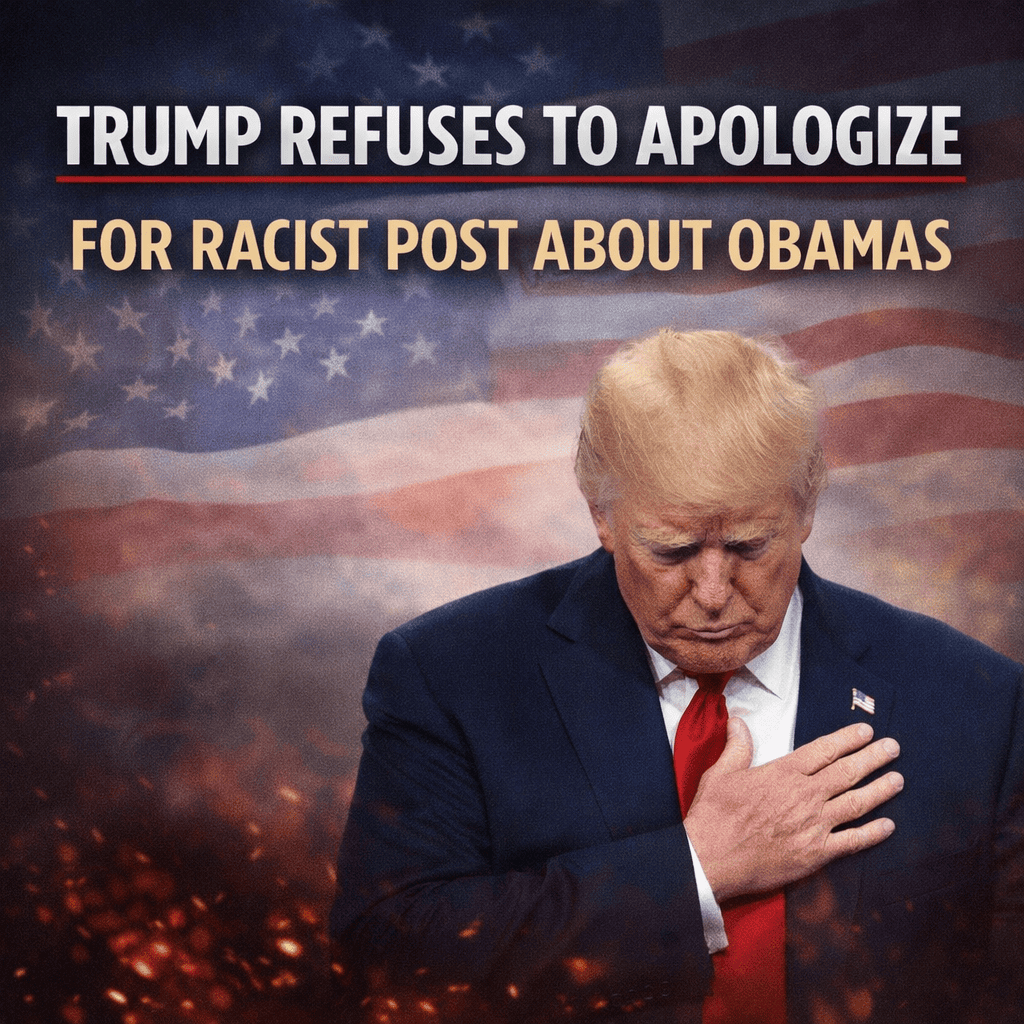
President Trump refuses to apologize for a racist post after a video shared on his social media platform depicted former President Barack Obama and former First Lady Michelle Obama using imagery long associated with racist dehumanisation. Although the post was deleted within hours, the response that followed has prolonged the controversy rather than contained it.
The video, shared briefly on Truth Social, combined recycled claims about election fraud with manipulated visuals that showed the Obamas portrayed as apes near the end of the clip. The content drew immediate condemnation from civil rights groups, lawmakers, and members of Trump’s own party. Despite this, Trump refuses to apologize for racist post, telling reporters he “didn’t make a mistake” and asserting that he had only viewed the beginning of the video before it was shared.
According to the White House, the post was uploaded by a staff member who failed to review the entire clip. Trump later said he disapproved of the racist imagery itself but maintained that responsibility lay elsewhere. That distinction has done little to defuse criticism, particularly because the account used belongs to the president and functions as an official communications channel.
The backlash has been unusually broad. Several Republican lawmakers publicly urged Trump to acknowledge wrongdoing and issue a clear apology. Senator Tim Scott described the post as overtly racist and said it crossed a line that explanations about staff error should not blur. Democrats echoed that view, arguing that leadership accountability does not end with deleting offensive content.
The incident has also revived scrutiny of Trump’s long digital record. From the “birther” conspiracy targeting Obama to repeated racially charged rhetoric, critics argue the latest episode fits an established pattern rather than an isolated lapse. In that context, Trump refuses to apologize for racist post, which is being interpreted less as defiance and more as confirmation of political instinct.
Timing has amplified the reaction. The post appeared during Black History Month, when racial language and symbolism carry heightened weight. Civil rights advocates warn that normalising such content, even briefly, reinforces stereotypes that have tangible consequences beyond politics, including threats and harassment.
From an operational standpoint, the episode exposes weaknesses in content governance at the highest level of government. A realistic solution would involve mandatory full‑content review for any reposted media, delayed publishing protocols for accounts tied to executive authority, and clear internal accountability when violations occur. These measures are standard in corporate crisis communications, yet remain inconsistently applied in political offices.
Looking ahead, Trump refuses to apologize for racist post, which may continue to reverberate through the 2026 political cycle. Speculation: rather than harming his core base, the controversy could harden existing support while further alienating swing voters and institutional allies. What is clear is that deletion alone no longer resets the narrative. In the current media environment, refusal to accept responsibility often becomes the story itself.