
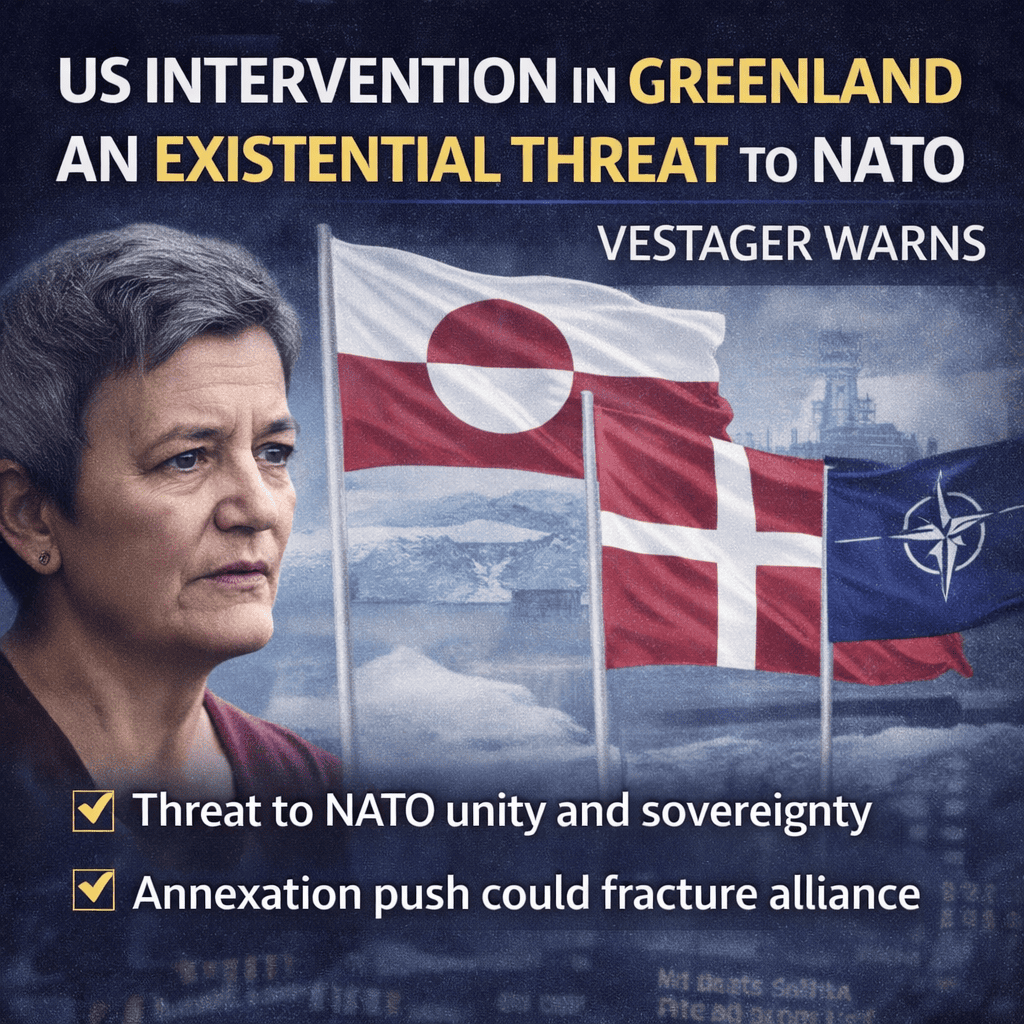
US intervention in Greenland is an existential threat, Margrethe Vestager warned, as debate intensifies over Washington’s renewed rhetoric about Greenland. The former European Commissioner and ex-Danish minister argues that any attempt by one NATO member to exert control over another ally’s territory would undermine the alliance’s very foundation.
Vestager’s concern is not symbolic. NATO’s credibility rests on a single assumption: members do not threaten each other’s sovereignty. If that principle erodes, collective defence becomes conditional. The deterrent effect of Article 5 weakens because adversaries can no longer assume unity inside the alliance. In that sense, US intervention in Greenland as an existential threat is a structural diagnosis, not a political flourish.
Greenland’s leadership has made its position explicit. The territory’s government has said its future is not for sale and that decisions about its status belong to Greenlanders. Denmark has echoed that stance, coordinating closely with Nuuk as high-level talks with Washington approach. European capitals view the episode as a test case: if alliance borders become negotiable between members, every frontier becomes more fragile.
The tension has moved beyond rhetoric. In the United States, lawmakers have introduced proposals to prevent any military action against NATO territories, explicitly including Greenland. That legislative push reflects growing concern that ambiguity itself can become destabilising. When allies begin to plan for worst-case scenarios involving each other, trust degrades long before any action is taken.
For Brussels, the risk is not limited to Greenland. The Arctic is emerging as a core strategic theatre, intersecting with energy routes, undersea infrastructure, satellite coverage, and great-power competition. If the Greenland question becomes bilateral rather than multilateral, NATO’s Arctic posture could fragment. That fragmentation would be visible to external actors, undermining deterrence across the High North.
What reduces risk without escalating conflict?
- Anchor sovereignty in alliance doctrine. NATO leadership and key capitals can issue a joint, unambiguous statement that Greenland’s status is governed by treaty and self-determination, not acquisition.
- Move Arctic security into multilateral frameworks. Surveillance, infrastructure protection, and readiness should be handled through NATO and allied commands, not bilateral bargaining.
- Build crisis-management architecture. A permanent Arctic coordination mechanism linking Denmark, Greenland, and allied commands would reduce the chance that miscalculation becomes confrontation.
- Create deterrence through clarity. Allies can align contingency measures—legal, economic, and defence-industrial—so that any breach of another member’s territory carries predictable consequences.
US intervention in Greenland is an existential threat that ultimately exposes a deeper reality: alliance cohesion is itself a strategic asset. Deterrence against external rivals depends on internal certainty. If that certainty erodes, the alliance becomes a collection of armed states rather than a unified system.
Vestager’s message is direct. The Greenland issue is not about geography. It is about whether NATO remains a rules-based alliance—or becomes a network held together only by convenience.